MCQ
Two unequal masses are tied together with a cord with a compressed spring in between. When the cord is burnt with a match releasing the spring, the two masses fly apart with equal
  • A
    Kinetic energy
  • B
    Speed
  • Momentum
  • D
    Acceleration

Answer

Correct option: C.
Momentum
Due to this the two masses fly apart and acquire veloatus in inverse momentum to their masses. Since the are formal forces zero they will fly apart with equal momentum.

Need a full question paper?

Generate a complete, print-ready paper with questions like this in minutes — across 16+ boards, with answer keys.
Start Generating Free

Similar questions

A tuning fork of frequency $340\, Hz$ is sounded above an organ pipe of length $120\, cm$. Water is now slowly poured in it. The minimum height of water column required for resonance is .... $cm$ (speed of sound in air $= 340 \,m/s$)
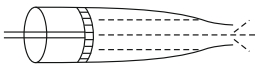
Figure below shows a liquid being pushed out of the tube by a piston having area of cross section $2.0\,cm ^2$. The area of cross section at the outlet is $10\,mm ^2$. If the piston is pushed at a speed of $4\,cm s ^{-1}$, the speed of outgoing fluidis $.........\,cm s ^{-1}$.
Under a pressure head the rate of orderly volume flow of a liquid through a capillary tube is $Q$ . If the length of capillary tube is doubled and the diameter of tube is halved, the rate of flow would become
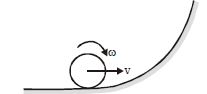
A solid sphere rolling without slipping on a horizontal rough surface and starts rising on inclined rough surface as shown in the figure assume pure rolling throughout the motion. Choose the $INCORRECT$ statement
Two particles $P$ and $Q$ start from origin and execute Simple Harmonic Motion along $X-$axis with same amplitude but with periods $3$ seconds and $6$ seconds respectively. The ratio of the velocities of $ P$ and $Q$ when they meet is
A particle of mass $0.2 \ kg$ is moving in one dimension under a force that delivers a constant power $0.5 \ W$ to the particle. If the initial speed (in $ms ^{-1}$ ) of the particle is zero, the speed $\left(\right.$ in $ms ^{-1}$ ) after $5s$ is :
Consider a body of mass $1.0 \mathrm{~kg}$ at rest at the origin at time $\mathrm{t}=0$. A force $\overrightarrow{\mathrm{F}}=(\alpha \mathrm{t} \hat{\mathrm{i}}+\beta \hat{\mathrm{j}})$ is applied on the body, where $\alpha=1.0 \mathrm{Ns}^{-1}$ and $\beta=1.0 \mathrm{~N}$. The torque acting on the body about the origin at time $\mathrm{t}=1.0 \mathrm{~S}$ is $\vec{\tau}$. Which of the following statements is (are) true?

$(A)$ $|\vec{\tau}|=\frac{1}{3} \mathrm{Nm}$

$(B)$ The torque $\vec{\tau}$ is in the direction of the unit vector $+\hat{\mathrm{k}}$

$(C)$ The velocity of the body at $\mathrm{t}=1$ is $\overrightarrow{\mathrm{v}}=\frac{1}{2}(\hat{\mathrm{i}}+2 \hat{\mathrm{j}}) \mathrm{m} \mathrm{s}^{-1}$

$(D)$ The magnitude of displacement of the body at $\mathrm{t}=1 \mathrm{~s}$ is $\frac{1}{6} \mathrm{~m}$
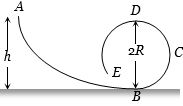
A frictionless track $ABCDE$ ends in a circular loop of radius $R$. A body slides down the track from point $A$ which is at a height $h = 5\, cm$. Maximum value of $R$ for the body to successfully complete the loop is ........... $\mathrm{cm}$
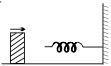
$A$ $1.0\, kg$ block collides with a horizontal weightless spring of force constant $2.75 Nm^{-1}$ as shown in figure. The block compresses the spring $4.0\, m$ from the rest position. If the coefficient of kinetic friction between the block and horizontal surface is $0.25$, the speed of the block at the instant of collision is ................. $\mathrm{m}/ \mathrm{s}^{-1}$
A liquid is coming out from a vertical tube. The relation between the weight of the drop $W$, surface tension of the liquid $T$ and radius of the tube $r$ is given by, if the angle of contact is zero