In an ionised sodium atom, an electron is moving in a circular path of radius $r$ with angular velocity $\omega $. The magnetic induction in $wb/m^2$ produced at the nucleus will be
Medium
Download our app for free and get started
$B=\left(\frac{\mu_{0}}{4 \pi}\right) \frac{2 \pi I}{r}$
Here $1=\frac{e}{T}=\frac{e \omega}{2 \pi} \therefore B=\left(\frac{\mu_{0}}{4 \pi}\right) \frac{2 \pi e \omega / 2 \pi}{r}$
i. $e . \mathrm{B}=\left(\frac{\mu_{0}}{4 \pi}\right) \frac{e \omega}{r}=10^{-7}=\frac{e \omega}{r} \times 10^{-7} T$

Download our appand get started for free
Experience the future of education. Simply download our apps or reach out to us for more information. Let's shape the future of learning together!No signup needed.*
Similar Questions
- 1An orbital electron in the ground state of hydrogen has magnetic moment $\mu_1$. This orbital electron is excited to $3^{rd}$ excited state by some energy transfer to the hydrogen atom. The new magnetic moment of the electron is $\mu_2$ , thenView Solution
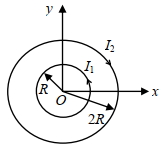
- 2Two concentric circular loops, one of radius $R$ and the other of radius $2 R$, lie in the $x y$-plane with the origin as their common center, as shown in the figure. The smaller loop carries current $I_1$ in the anti-clockwise direction and the larger loop carries current $I_2$ in the clockwise direction, with $I_2>2 I_1 . \vec{B}(x, y)$ denotes the magnetic field at a point $(x, y)$ in the $x y$-plane. Which of the following statement($s$) is(are) current?View Solution
$(A)$ $\vec{B}(x, y)$ is perpendicular to the $x y$-plane at any point in the plane
$(B)$ $|\vec{B}(x, y)|$ depends on $x$ and $y$ only through the radial distance $r=\sqrt{x^2+y^2}$
$(C)$ $|\vec{B}(x, y)|$ is non-zero at all points for $r$
$(D)$ $\vec{B}(x, y)$ points normally outward from the $x y$-plane for all the points between the two loops
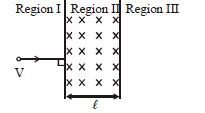
- 3A particle of mass $m$ and charge $q$ , moving with velocity $V$ enters region $II$ normal to the boundary as shown in the figure. Region $II$ has a uniform magnetic field $B$ perpendicular to the plane of the paper. The length of the region $II$ is $l$ . Choose the not correct choiceView Solution
- 4Current $i$ is carried in a wire of length $L$. If the wire is turned into a circular coil, the maximum magnitude of torque in a given magnetic field $B$ will beView Solution
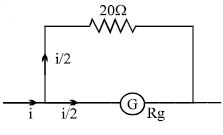
- 5In a galvanometer, the deflection becomes one half when the galvanometer is shunted by a $20\,\,\Omega$ resistor. The galvanometer resistance is ............... $\Omega$View Solution
- 6A galvanometer of resistance $20 \,\Omega$ is to be converted into an ammeter of range $1\, A$. If a current of $1\, mA$ produces full scale deflection, the shunt required for the purpose is ................ $\Omega $View Solution
- 7View SolutionField inside a solenoid is
- 8A thin rod is bent in the shape of a small circle of radius $'r'$. If the charge per unit length of the rod is $'\sigma ',$ and if the circle is rotated about its axis at the rate of $'n'$ rotation per second, the magnetic induction at a point on the axis at a large distance $'y'$ from the centre isView Solution
- 9If a proton enters perpendicularly a magnetic field with velocity $v$, then time period of revolution is $T$. If proton enters with velocity $2 v$, then time period will beView Solution
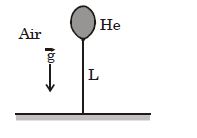
- 10A light balloon filled with helium of density $\rho_{He}$ is tied to a light string of length $L.$ The string is tied to the ground forming an "inverted" simple pendulum (figure). If the balloon is displaced slightly from equilibrium as in figure and released, the period of the motion is. Take the density of air to be $\rho_{air}$. Assume the air applies a buoyant force on the balloon but does not otherwise affect its motion.)View Solution