- A$\lambda_1,\lambda_2$ are constants
- B$\lambda_1$ and $\lambda_2$ are variable
- C$\lambda_1$ is variable $\lambda_2$ is constant
- D$\lambda_2$ is variable, $\lambda_1$ is constant
Explanation:
Velocity of a wave is given by:
$\text{v}=\frac{\text{E}}{\text{B}}$
Hence wave velocity change in both the cases.
Frequency of the wave remains the same.
Using $\text{v}=\text{f}\lambda,$ it can be concluded that both $\lambda_1$ and $\lambda_2$ are variable.
Generate a complete, print-ready paper with questions like this in minutes — across 16+ boards, with answer keys.
Einstein got Nobel prize on which of the following works
|
(a) Mass-energy relation |
(b) Special theory of relativity |
|
(c) Photoelectric equation |
(d) (a) and (b) both |
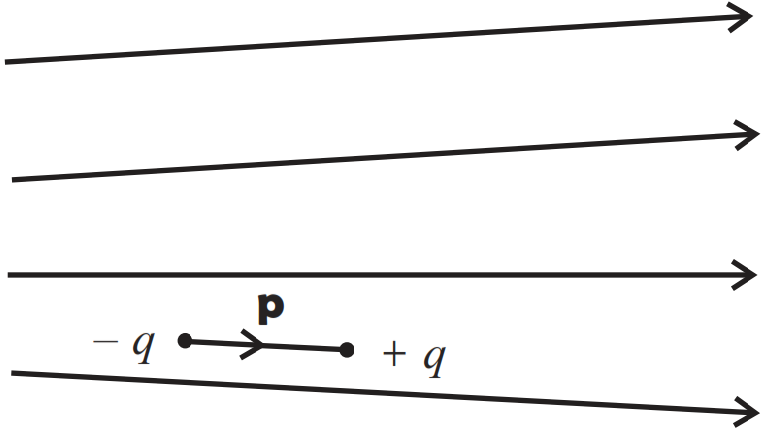
The torque acting on a dipole of moment
in an electric field
is
|
(a) |
(b) |
(c) Zero |
(d) |

A convex lens forms a real image of an object for its two different positions on a screen. If height of the image in both the cases be 8 cm and 2 cm, then height of the object is
|
(a) 16 cm |
(b) 8 cm |
(c) 4 cm |
(d) 2 cm |
A metallic block carrying current I is subjected to a uniform magnetic induction as shown in the figure. The moving charges experience a force
given by ........... which results in the lowering of the potential of the face ........ Assume the speed of the carriers to be v
|
(a) eVB |
(b) eVB |
(c) -eVB |
(d) -eVB |