Two waves having the intensities in the ratio of $9 : 1$ produce interference. The ratio of maximum to the minimum intensity, is equal to
Medium


Download our appand get started for free
Experience the future of education. Simply download our apps or reach out to us for more information. Let's shape the future of learning together!No signup needed.*
Similar Questions
- 1Select the correct statement about the reflection and refraction of a wave at the interface between the medium $1$ and $2$ theView Solution
- 2At standard temperature and pressure the density of a gas is $1.3$ $kg/{m^3}$ and the speed of the sound in gas is $330\, m/sec.$ Then the degree of freedom of the gas will beView Solution
- 3If the velocity of sound in air is $350 m/s$. Then the fundamental frequency of an open organ pipe of length $50\,cm,$ will be ............... $\mathrm{Hz}$View Solution
- 4A musician using an open flute of length $50\,cm$ produces second harmonic sound waves. A person runs towards the musician from another end of a hall at a speed of $10 \,km/h.$ If the wave speed is $330\,m/s,$ the frequency heard by the running person shall be close to...... $Hz$View Solution
- 5If the length of a closed organ pipe is $1m $ and velocity of sound is $330 m/s$, then the frequency for the second note isView Solution
- 6A sound source of frequency $170 Hz$ is placed near a wall. A man walking from a source towards the wall finds that there is a periodic rise and fall of sound intensity. If the speed of sound in air is $340\, m/s$ the distance (in metres) separating the two adjacent positions of minimum intensity isView Solution
- 7A wave is represented by the equation : $y = a\sin (0.01x - 2t)$ where $a$ and $x$ are in $cm$. velocity of propagation of wave is .... $cm/s$View Solution
- 8View SolutionThe diagram below shows the propagation of a wave. Which points are in same phase
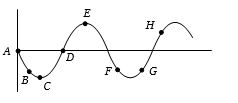
- 9A vibrating string of certain length $\ell$ under a tension $\mathrm{T}$ resonates with a mode corresponding to the first overtone (third harmonic) of an air column of length $75 \mathrm{~cm}$ inside a tube closed at one end. The string also generates $4$ beats per second when excited along with a tuning fork of frequency $\mathrm{n}$. Now when the tension of the string is slightly increased the number of beats reduces $2$ per second. Assuming the velocity of sound in air to be $340 \mathrm{~m} / \mathrm{s}$, the frequency $\mathrm{n}$ of the tuning fork in $\mathrm{Hz}$ isView Solution
- 10Speed of a transverse wave on a straight wire (mass $6.0\; \mathrm{g}$, length $60\; \mathrm{cm}$ and area of cross-section $1.0\; \mathrm{mm}^{2}$ ) is $90\; \mathrm{ms}^{-1} .$ If the Young's modulus of wire is $16 \times 10^{11}\; \mathrm{Nm}^{-2},$ the extension of wire over its natural length isView Solution