Two waves of intensity ratio $1: 9$ cross each other at a point. The resultant intensities at the point, when $I_1(a)$ Waves are incoherent is $I_1(b)$ Waves are coherent is $I_2$ and differ in phase by $60^{\circ}$. If $\frac{I_1}{I_2}=\frac{10}{x}$ than $x$ =. . . . . . . . . . .
JEE MAIN 2024, Diffcult


Download our appand get started for free
Experience the future of education. Simply download our apps or reach out to us for more information. Let's shape the future of learning together!No signup needed.*
Similar Questions
- 1Two identical strings $X$ and $Z$ made of same material have tension $T _{ x }$ and $T _{ z }$ in them. If their fundamental frequencies are $450\, Hz$ and $300\, Hz ,$ respectively, then the ratio $T _{ x } / T _{ z }$ is$.....$View Solution
- 2The distance between two consecutive crests in a wave train produced in a string is $5 cm.$ If $2$ complete waves pass through any point per second, the velocity of the wave is ..... $cm/sec$View Solution
- 3The persistence of sound in a room after the source of sound is turned off is called reverberation. The measure of reverberation time is the time required for sound intensity to decrease by $60 \,dB$. It is given that the intensity of sound falls off as $I_0 \exp \left(-c_1 \alpha\right)$ where $I_0$ is the initial intensity, $c_1$ is a dimensionless constant with value $1 / 4$. Here, $\alpha$ is a positive constant which depends on the speed of sound, volume of the room, reverberation time, and the effective absorbing area $A_e$. The value of $A_e$ is the product of absorbing coefficient (with value between $0$ and $1,1$ being a perfect absorber) and the area of the room. For a concert hall of volume $600 \,m ^3$, the value of $A_e$ (in $m ^2$ ) required to give a reverberation time of $1 s$ is closest to (speed of sound in air $=340 \,m / s$ )View Solution
- 4Fundamental frequency of an open pipe of length $0.5 m$ is equal to the frequency of the first overtone of a closed pipe of length $l$. The value of $l_c$ is $(m)$View Solution
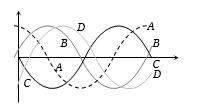
- 5Which of the following curves represents correctly the oscillation given by $y = {y_0}\sin (\omega \,t - \phi )$, where $0 < \phi < 90$View Solution
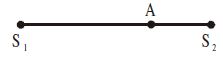
- 6If $y_1 = 5 (mm)\ \sin\pi t$ is equation of oscillation of source $S_1$ and $y_2$ $=$ $5$ $(mm)$ $sin(\pi t + \pi /6)$ be that of $S_2$ and it takes $1$ $sec$ and $\frac{1}{2}\ sec$ for the transverse waves to reach point $A$ from sources $S_1$ and $S_2$ respectively then the resulting amplitude at point $A$, is .... $mm$View Solution
- 7If amplitude of waves at distance $r$ from a point source is $A$, the amplitude at a distance $2r$ will beView Solution
- 8The wave function of a pulse is given by $y=\frac{5}{(4 x+6 t)^2}$, where $x$ and $y$ are in metre and $t$ is in second. The velocity of pulse is ......... $m / s$View Solution
- 9An open organ pipe of length $l$ is sounded together with another organ pipe of length $l + x$ in their fundamental tones $(x < < l)$. The beat frequency heard will be (speed of sound is $v$) :View Solution
- 10View SolutionIf the amplitude of sound is doubled and the frequency reduced to one-fourth, the intensity of sound at the same point will be