Fundamental frequency of an open pipe of length $0.5 m$ is equal to the frequency of the first overtone of a closed pipe of length $l$. The value of $l_c$ is $(m)$
Medium
Download our app for free and get started
(b) First tone of open pipe = first overtone of closed pipe
$\Rightarrow$$\frac{v}{{2{l_0}}} = \frac{{3v}}{{4{l_c}}}$
$\Rightarrow$${l_c} = \frac{{3 \times 2 \times 0.5}}{4} = 0.75m$

Download our appand get started for free
Experience the future of education. Simply download our apps or reach out to us for more information. Let's shape the future of learning together!No signup needed.*
Similar Questions
- 1Equation of a progressive wave is given by $y = 0.2\cos \pi \left( {0.04t + 0.02x - \frac{\pi }{6}} \right)$The distance is expressed in $cm$ and time in second. What will be the minimum distance between two particles having the phase difference of $\pi /2$ ...... $cm$View Solution
- 2A stretched string of $1m$ length and mass $5 \times {10^{ - 4}}kg$ is having tension of $20N.$ If it is plucked at $25cm$ from one end then it will vibrate with frequency ... $Hz$View Solution
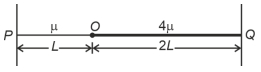
- 3Two uniform strings of mass per unit length $\mu$ and $4 \mu$, and length $L$ and $2 L$, respectively, are joined at point $O$, and tied at two fixed ends $P$ and $Q$, as shown in the figure. The strings are under a uniform tension $T$. If we define the frequency $v_0=\frac{1}{2 L} \sqrt{\frac{T}{\mu}}$, which of the following statement($s$) is(are) correct?View Solution
$(A)$ With a node at $O$, the minimum frequency of vibration of the composite string is $v_0$
$(B)$ With an antinode at $O$, the minimum frequency of vibration of the composite string is $2 v_0$
$(C)$ When the composite string vibrates at the minimum frequency with a node at $O$, it has $6$ nodes, including the end nodes
$(D)$ No vibrational mode with an antinode at $O$ is possible for the composite string
- 4A person blows into open-end of a long pipe. As a result, a high-pressure pulse of air travels down the pipe. When this pulse reaches the other end of the pipe.View Solution
$(A)$ a high-pressure pulse starts traveling up the pipe, if the other end of the pipe is open.
$(B)$ a low-pressure pulse starts traveling up the pipe, if the other end of the pipe is open.
$(C)$ a low-pressure pulse starts traveling up the pipe, if the other end of the pipe is closed.
$(D)$ a high-pressure pulse starts traveling up the pipe, if the other end of the pipe is closed.
- 5The speed of a wave in a medium is $760\, m/s$. If $3600 $ waves are passing through a point, in the medium in $2$ minutes, then its wavelength is ...... $m$View Solution
- 6An observer starts moving with uniform acceleration $a$ toward a stationary sound source emitting a whistle of frequency $n.$ As the observer approaches source, the apparent frequency, heard by the observer varies with time asView Solution
- 7A stationary source emits sound waves of frequency $500\, Hz$. Two observers moving along a line passing through the source detect sound to be of frequencies $480\, Hz$ and $530\, Hz$. Their respective speeds are, in $m\,s^{-1}$ (Given speed of sound $= 300\, m/s$)View Solution
- 8A man is watching two trains, one leaving and the other coming with equal speed of $4\,m/s$. If they sound their whistles each of frequency $240\, Hz$, the number of beats per sec heard by man will be equal to (velocity of sound in air $= 320\, m/s$)View Solution
- 9The equation of progressive wave is $y = a\sin (200\,t - x)$. where $x$ is in meter and $t$ is in second. The velocity of wave is ..... $m/sec$View Solution
- 10A tuning fork and an air column whose temperature is $51^{\circ} C$ produce $4$ beats in one second, when sounded together. When the temperature of air column decreases the number of beats per second decreases. When the temperature remains $16^{\circ} C$ only one beat per second is produced. The frequency of the tuning fork is ........... $Hz$View Solution