MCQ
Two waves represented by the following equations are travelling in the same medium ${y_1} = 5\sin 2\pi (75t - 0.25x)$, ${y_2} = 10\sin 2\pi (150t - 0.50x)$ The intensity ratio ${I_1}/{I_2}$ of the two waves is
  • A
    $1:2$
  • $1:4$
  • C
    $1:8$
  • D
    $1:16$

Answer

Correct option: B.
$1:4$
b
(b) $\frac{{{I_1}}}{{{I_2}}} = \frac{{a_1^2}}{{a_2^2}} $

$\Rightarrow \frac{{{I_1}}}{{{I_2}}} = \frac{{25}}{{100}} = \frac{1}{4}$

Need a full question paper?

Generate a complete, print-ready paper with questions like this in minutes — across 16+ boards, with answer keys.
Start Generating Free

Similar questions

The maximum velocity at the lowest point, so that the string just slack at the highest point in a vertical circle of radius $l$
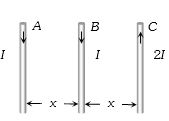
$A, B$ and $C$ are parallel conductors of equal length carrying currents $I, I$ and $2I$ respectively. Distance between $A$ and $B$ is $x$. Distance between $B$ and $C$ is also $x$. ${F_1}$ is the force exerted by $B$ on $A$ and $F_2$ is the force exerted by $B$ on $A$ choose the correct answer
A small telescope has an objective of focal length $140$ ~$cm$ and an eye piece of focal length $5.0 ~cm$. The magnifying power of telescope for viewing a distant object is:
Consider an electron in a hydrogen atom, revolving in its second excited state (having radius $4.65\, \mathop A\limits^o $). The de-Broglie wavelength of this electron is....$\mathop A\limits^o $
A spectrum is formed by a prism of dispersive power $'\omega '$. If the angle of deviation is $'\delta '$, then the angular dispersion is
A wheel initially at rest, is rotated with a uniform angular acceleration. The wheel rotates through an angle ${\theta _1}$ in first one second and through an additional angle ${\theta _2}$ in the next one second. The ratio $\frac{{{\theta _2}}}{{{\theta _1}}}$ is
Molar specific heat at constant volume, for a non-linear triatomic gas is (vibration mode neglected)
Given vector $\overrightarrow A = 2\hat i + 3\hat j, $ the angle between $\overrightarrow A $and $y-$axis is
A body of mass $1 kg$ begins to move under the action of a time dependent force $\vec{F}=\left(t \hat{i}+3 t^2 \hat{ j }\right) N$. where $\hat{i}$ and $\hat{j}$ are the unit vectors along $x$ and $y$ axis. The power developed by above force, at the time $t=2 s$. will be $..............W$.
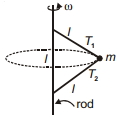
In the figure, a ball of mass $m$ is tied with two strings of equal length as shown. If the rod is rotated with angular velocity $\omega$, then