Question
Two wires carrying equal currents i each, are placed perpendicular to each other, just avoiding a contact. If one wire is held fixed and the other is free to move under magnetic forces, what kind of motion will result?

Answer

The magnetic force on a wire carrying an electric current i is $\overrightarrow{\text{F}}=\text{i}.\big(\overrightarrow{\text{l}}\times\overrightarrow{\text{B}}\big),$ where l is the length of the wire and B is the magnetic field acting on it. Suppose we have one wire in the horizontal direction (fixed) and other wire in the vertical direction (free to move). If the horizontal wire is carrying current from right to left is held fixed perpendicular to the vertical wire, which is free to move, the upper portion of the free wire will tend to move in the left direction and the lower portion of the wire will tend to move in the right direction, according to Fleming's left hand rule, as the magnetic field acting on the wire due to the fixed wire will point into the plane of paper above the wire and come out of the paper below the horizontal wire and the current will flow in upward direction in the free wire. Thus, the free wire will tend to become parallel to the fixed wire so as to experience maximum attractive force.

Need a full question paper?

Generate a complete, print-ready paper with questions like this in minutes — across 16+ boards, with answer keys.
Start Generating Free

Similar questions

Prove the following:
  1. For two angles of projection $\theta$ and $(90-\theta)$ with same velocity v,
  1. Range is same.
  2. Heights are in the ratio $\tan^2: 1$.
  1. If the range and maximum height are equal, the angle of projection is $\tan^{-1}(4)$.
The position of a particle is given by $\text{r}=3.0\text{t}\hat{\text{i}}-2.0\text{t}^2\hat{\text{j}}+4.0\hat{\text{k }}\text{m}$ Where t is in seconds and the coefficients have the proper units for r to be in metres. (a) Find the v and a of the particle? (b) What is the magnitude and direction of velocity of the particle at t = 2.0s?
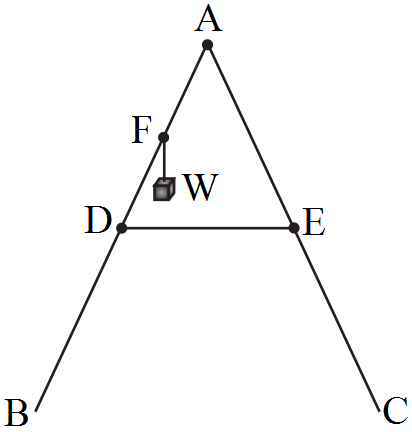
As shown in the two sides of a step ladder BA and CA are $1.6m$ long and hinged at A. A rope DE, $0.5m$ is tied half way up. A weight $40kg$ is suspended from a point F, 1.2m from B along the ladder BA. Assuming the floor to be frictionless and neglecting the weight of the ladder, find the tension in the rope and forces exerted by the floor on the ladder. (Take $g = 9.8m/s^2$) (Hint: Consider the equilibrium of each side of the ladder separately).
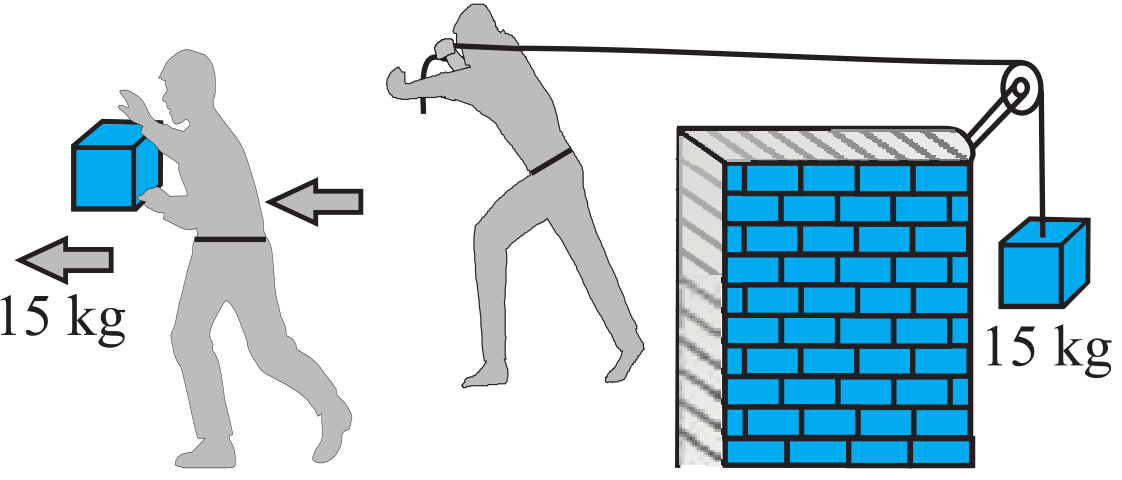
Answer the following: In the man walks $2m$ carrying a mass of $15kg$ on his hands. In he walks the same distance pulling the rope behind him. The rope goes over a pulley, and a mass of $15kg$ hangs at its other end. In which case is the work done greater?
The plates of a capacitor of capacitance $10\mu\text{F},$ charged to $60\mu\text{C},$ are joined together by a wire of resistance $10\Omega$ at t = 0. Find the charge on the capacitor in the circuit at (a) t = 0 (b) $\text{t}=30\mu\text{s}$ (c) $\text{t}=120\mu\text{s}$ and (d) t = 1.0ms.
Explain Doppler effect in sound. Obtain an expression for apparent frequency of sound when source and listener are approaching each other.
A bucket full of water is placed in a room at $15^\circ C$ with initial relative humidity $40\%$. The volume of the room is $50m^3.$
  1. How much water will evaporate?
  2. lf the room temperature is increased by $5^\circ C, $ how much more water will evaporate? The saturation vapour pressure of water at $15^\circ C$ and $20^\circ C$ are $1.6$kPa and $2.4$kPa respectively.
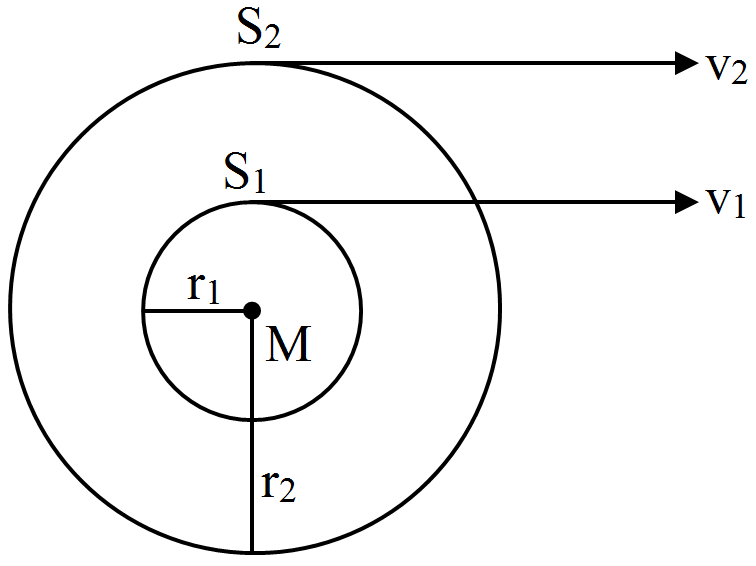
Two satellites $S_1$ and $S_2$ revolve round a planet in coplanar circular orbit in the same sense. Their periods of revolution are one hour and $8$ hours respectively. The radius of the orbit of $S_1$ is $10^4km$. When $S_2$ is close to $S_1$ find:
  1. The speed of $S_2$ relative to $S_1$.
  2. The angular speed of $S_2$ as actually observed by an astronaut in $S_1$.
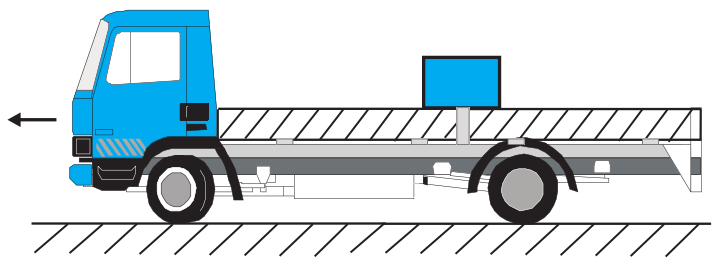
The rear side of a truck is open and a box of $40kg$ mass is placed $5m$ away from the open end as shown in Fig. The coefficient of friction between the box and the surface below it is $0.15$. On a straight road, the truck starts from rest and accelerates with $2ms^{-2}$. At what distance from the starting point does the box fall off the truck? (Ignore the size of the box).
Two parallel wires seprated by a distance of 10cm carry currents of 10A and 40A along-the same direction. Where should a third current be placed so that it experiences no magnetic force?