MCQ
Ultrasonic waves are those waves
  • A
    To which man can hear
  • Man can't hear
  • C
    Are of high velocity
  • D
    Of high amplitude

Answer

Correct option: B.
Man can't hear
b
(b) Ultrasonic waves are those of higher frequencies than maximum audible range frequencies (audible range of frequencies is $20 \,H$z to $20000 \,Hz$)

Need a full question paper?

Generate a complete, print-ready paper with questions like this in minutes — across 16+ boards, with answer keys.
Start Generating Free

Similar questions

If the degree of freedom of a gas are $f,$ then the ratio of two specific heats ${C_P}/{C_V}$ is given by
An object falling through a fluid is observed to have acceleration given by $a = g -bv$ where $g =$ gravitational acceleration and $b$ is constant. After a long time of release, it is observed to fall with constant speed. The value of constant speed is
The product of the pressure and volume of an ideal gas is
A particle of mass m is hanging vertically by an ideal spring of force constant K. If the mass is made to oscillate vertically, its total energy is
A soap bubble assumes a spherical surface. Which of the following statement is wrong
A body freely falling from the rest has a velocity $v$ after his falls through a height $h.$ The distance, it has to fall down further for its velocity to become double, is:
A composition string is made up by joining two strings of different masses per unit length $\rightarrow \mu$ and $4\mu$ . The composite string is under the same tension. A transverse wave pulse $: Y = (6 mm) \,\,sin\,\,(5t + 40x),$ where $‘t’$ is in seconds and $‘x’$ in meters, is sent along the lighter string towards the joint, the percentage of power transmitted to the heavier string through the joint is approximately ..... $\%$
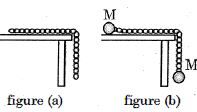
A chain lying on an absolutely smooth table, half of it hanging over the edge of the table as shown in figure $(a)$. The time it takes to slip off the table is affected if two equal weights be attached, one to each end as shown in figure $(b)$ .
$t_a$ : time taken to slip in situation $'a'$
$t_b$ : time taken to slip in situation $'b'$
The source producing sound and an observer both are moving along the direction of propagation of sound waves. If the respective velocities of sound, source and an observer are $v,  {v_s}$ and ${v_o}$, then the apparent frequency heard by the observer will be ($n =$ frequency of sound)
The relation between time and distance is $t = \alpha {x^2} + \beta x$, where $\alpha $ and $\beta $ are constants. The retardation is