Question
Unless the vector and source DNAs are cut, fragments separated and joined, the desired recombinant vector molecules cannot be created.
  1. How are the desired DNA sequences cut?
  2. Explain the technique used to separate the cut fragments.
  3. How are the resultant fragments joined to the vector molecule?
Answer

  1.  
  • The purified DNA molecule containing the desired gene is incubated with the specific restriction endonuclease, at optimal conditions of pH, temperature, etc. of that enzyme.
  • Similarly, the vector DNA is also incubated with the same restriction endonuclease under optimal conditions.
  • This results into cutting of the DNA into fragments.
  1.  
  • Gel electrophoresis is used to separate the DNA fragments produced by restriction digestion.
  • The DNA fragments resolve according to their sizes, through the sieving effect provided bythe agarose gel.
  1. The resultant fragments are joined to the vector by use of DNA-ligases.

Need a full question paper?

Generate a complete, print-ready paper with questions like this in minutes — across 16+ boards, with answer keys.

Start Generating Free

Similar questions

Which methodology is used while sequencing the total DNA from a cell? Explain it in detail.
Describe the evidence of evolution from comparative anatomy and morphology?
“Phenylketonuria is a good example that explains Pleiotropy.” Justify.
What are recombinant DNA vaccines? Give two examples of such vaccines. Discuss their advantages.
Differentiate between incomplete dominance and co-dominance. Substantiate your answer with one example of each.
Answer the following questions:
Endosperm development precedes embryo development. Why?
A few statements are given below followed by a set of terms in a box. Pick the correct term and write it against the appropriate statement,
  1. Mating of closely related individuals within the same breed.
  2. Mating of animals of same breed but having no common ancestors on either side for 4-6 generations.
  3. Mating of animals of two different species.
  4. Breeding of animals belonging to different breeds.
  1. Cross breeding.
  2. Inter-specific hybridization.
  3. Out breeding.
  4. Out crossing.
  5. Inbreeding.
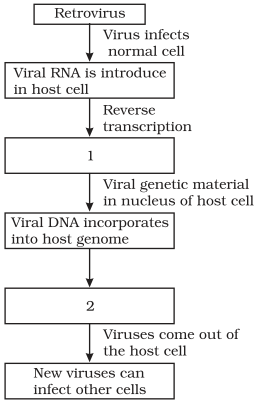
In the given flow diagram, the replication of retrovirus in a host is shown. Observe and answer the following questions,
  1. Fill in (1) and (2).
  2. Why is the virus called retrovirus?
  3. Can the infected cell survive while viruses are being replicated and released?
Answer the following questions:
Name the organs where gametogenesis gets completed in human male and female, respectively.
Describe in detail the multiple allelism by the help of inheritance of human blood group.