Question
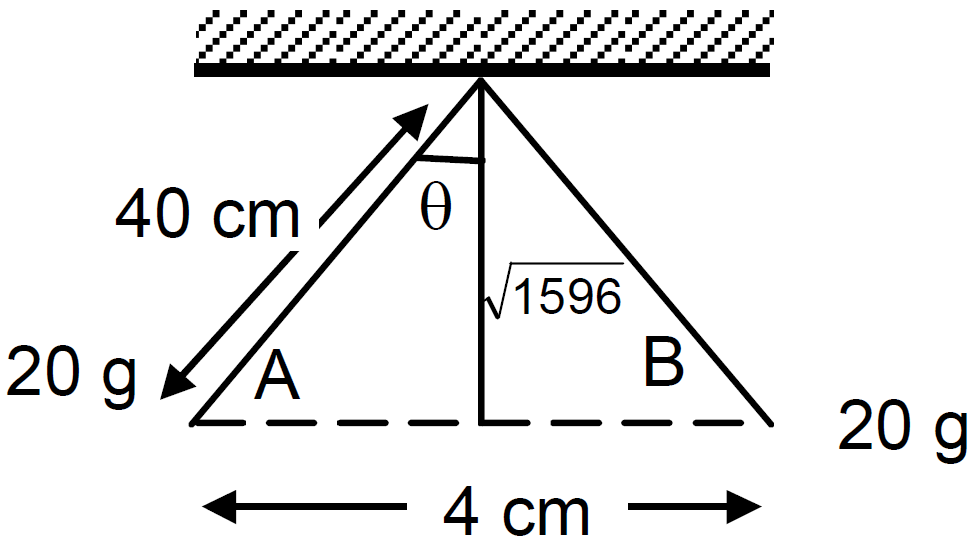
Two small spheres, each having a mass of 20g, are suspended from a common point by two insulating strings of length 40cm each. The spheres are identically charged and the separation between the balls at equilibrium is found to be 4cm. Find the charge on each sphere.
Answer


$\text{T}\cos\theta=\text{mg}\ \dots(1)$
$\text{T}\sin\theta=\text{Fe}\ \dots(2)$
Solving, $\frac{(2)}{(1)}$ we get, $\tan\theta=\frac{\text{Fe}}{\text{mg}}$
$=\frac{\text{kq}^2}{\text{r}}\times\frac{1}{\text{mg}}$
$\Rightarrow\frac{2}{\sqrt{1596}}=\frac{9\times10^9\times\text{q}^2}{(0.04)^2\times0.02\times9.8}$
$\Rightarrow\text{q}^2=\frac{(0.04)^2\times0.02\times9.8\times2}{9\times10^9\times\sqrt{1596}}$
$=\frac{6.27\times10^{-4}}{9\times10^9\times39.95}$
$=17\times10^{-16}\text{c}^2$
$\Rightarrow\text{q}=\sqrt{17\times10^{-16}}$
$=4.123\times10^{-8}\text{c}$

Need a full question paper?

Generate a complete, print-ready paper with questions like this in minutes — across 16+ boards, with answer keys.

Start Generating Free

Similar questions

A baloon filled with helium rises against gravity increasing its potential energy. The speed of the baloon also increases as it rises. How do you reconcile this with the law of conservation of mechanical energy? You can neglect viscous drag of air and assume that density of air is constant.
If c is r.m.s. speed of molecules in a gas and v is the speed of sound waves in the gas, show that c/ v is constant and independent of temperature for all diatomic gases.
Earth’s orbit is an ellipse with eccentricity $0.0167$. Thus, earth’s distance from the sun and speed as it moves around the sun varies from day to day. This means that the length of the solar day is not constant through the year. Assume that earth’s spin axis is normal to its orbital plane and find out the length of the shortest and the longest day. A day should be taken from noon to noon. Does this explain variation of length of the day during the year?
A faulty barometer contains certain amount of air and saturated water vapour. It reads 74.0cm when the atmospheric pressure is 76.0cm of mercury and reads 72.10cm when the atmospheric pressure is 74.0cm of mercury. Saturation vapour pressure at the air temperature = 1.0cm of mercury. Find the length of the barometer tube above the mercury level in the reservoir
As shown in the two sides of a step ladder BA and CA are 1.6m long and hinged at A. A rope DE, 0.5m is tied half way up. A weight 40kg is suspended from a point F, 1.2m from B along the ladder BA. Assuming the floor to be frictionless and neglecting the weight of the ladder, find the tension in the rope and forces exerted by the floor on the ladder. (Take $g = 9.8m/s^2$​​​​​​​) (Hint: Consider the equilibrium of each side of the ladder separately).
 
A uniform chain of length L and mass M overhangs a horizontal table with its two third part on the table. The friction coefficient between the table and the chain is $\mu.$ Find the work done by the friction during the period the chain slips off the table.
The two rods shown in figure, have identical geometrical dimensions. They are in contact with two heat baths at temperatures $100^{\circ} \mathrm{C}$ and $0^{\circ} \mathrm{C}$. The temperature of the junction is $70^{\circ} \mathrm{C}$. Find the temperature of the junction if the rods are interchanged.
An ideal gas at pressure $2.5 \times 10^5Pa$ and temperature $300K$ occupies $100cc$. It is adiabatically compressed to half its original volume. Calculate,
  1. The final pressure.
  2. The final temperature.
  3. The work done by the gas in the process. Take $\gamma=1.5.$
A cylinder of mass $5kg$ and radius $30cm$ and free to rotate about its axis, receives an angular impulse of $3kgm^2 s^{-1}$ followed by a similar impulse after every $4$ seconds. What is the angular speed of the cylinder $30s$ after the initial impulse? The cylinder is at rest initially.
Demonstrate free forced and resonant oscillations.