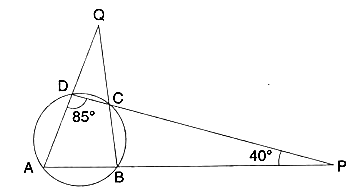
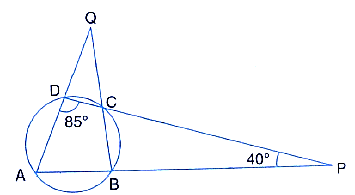
Use the given figure to find:
(i) ∠BAD,
(ii) ∠DQB
Exercise 17 (A) | Q 47 | Page 261
Download our app for free and get startedPlay store

(i) By angle sum property of ∆ADP,
∠BAD = 180° - 85° - 40° = 55°
(ii) ∠ABC = 180° - ∠ADC = 180° - 85° = 95°
(pair of opposite angles in a cyclic quadrilateral are supplementary)
By angle sum property,
∠AQB = 180° - 95° - 55°
⇒ ∠DQB = 30°
art

Download our app
and get started for free

Experience the future of education. Simply download our apps or reach out to us for more information. Let's shape the future of learning together!No signup needed.*

Similar Questions

  • 1
    In the given figure, the centre O of the small circle lies on the circumference of the bigger circle. If ∠APB = 75° and ∠BCD = 40°, find : ∠AOB
    View Solution
  • 2
    In the figure, given alongside, CP bisects angle ACB. Show that DP bisects angle ADB.
    View Solution
  • 3
    In a regular pentagon ABCDE, Inscribed in a circle; find ratio between angle EDA and angle ADC.
    View Solution
  • 4
    In the given figure, O is the centre of the circle. If ∠AOB = 140° and ∠OAC = 50°; Find:
    (i) ∠ACB, (ii) ∠OBC, (iii) ∠OAB, (iv) ∠CBA.
    View Solution
  • 5
    ABCD is a cyclic quadrilateral in which AB is parallel to DC and AB is a diameter of the circle. Given ∠BED = 65°; Calculate:
    (i) ∠DAB, (ii) ∠BDC
    Image
    View Solution
  • 6
    In the figure, given below, P and Q are the centres of two circles intersecting at B and C ACD is a straight line. Calculate the numerical value of x .
    Image
    View Solution
  • 7
    In the given figure, SP is bisector of ∠RPT and PQRS is a cyclic quadrilateral. Prove that SQ = SR .
    Image
    View Solution
  • 8
    In the given figure, RS is a diameter of the circle. NM is parallel to RS and ∠MRS = 29°.
    Calculate : ∠ NRM
    View Solution
  • 9
    In the given figure, AB is a diameter of the circle. Chord ED is parallel to AB and ∠EAB = 63°. Calculate : ∠ BCD.
    View Solution
  • 10
    In the given figure, $A O B$ is a diameter and $D C$ is parallel to $A B$. If $\angle C A B=x^0$; find (in terms of $x$ ) the values of: $\angle$ ADC.
    View Solution