Question
  1. Using Biot-Savart’s law, derive the expression for the magnetic field in the vector form at a point on the axis of a circular current loop.
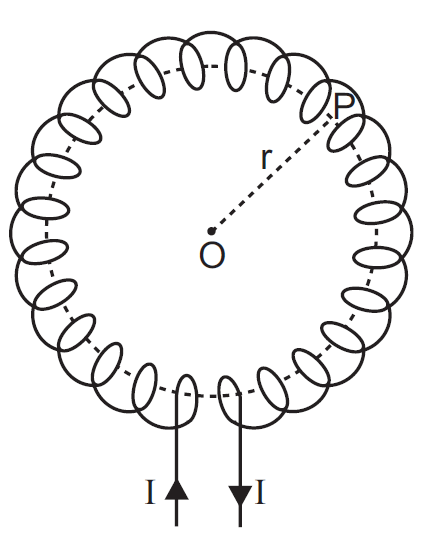
  2. What does a toroid consist of ? Find out the expression for the magnetic field inside a toroid for N turns of the coil having the average radius r and carrying a current I. Show that the magnetic field in the open space inside and exterior to the toroid is zero.
Answer

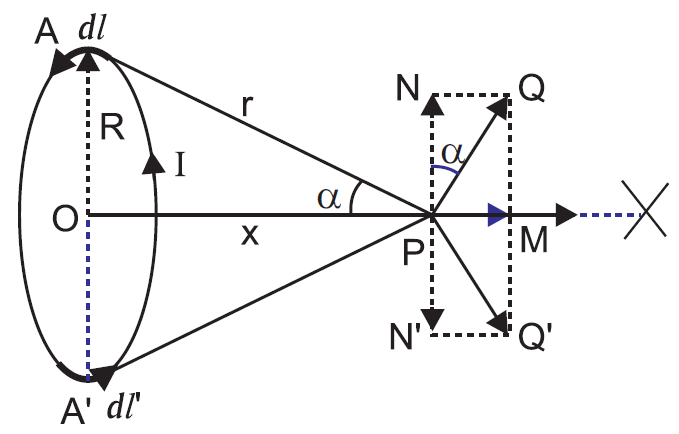
  1. Magnetic field at the axis of a circular loop: Consider a circular loop of radius R carrying current I, with its plane perpendicular to the plane of paper. Let P be a point of observation on the axis of this circular loop at a distance x from its centre O. Consider a small element of length dl of the coil at point A. The magnitude of the magnetic induction $\overrightarrow{\text{dB}}$at point P due to this element is given by


$\overrightarrow{\text{dB}}= \frac{\mu_{0}}{4\pi}\frac{\text{I}\delta\text{l}\sin\alpha}{\text{r}^{2}}$ - - - - - - (1)

The direction of $\overrightarrow{\text{dB}}$ is perpendicular to the plane containing $\overrightarrow{\text{dl}}$ and $\overrightarrow{\text{r}}$ and is given by right hand screw rule. As the angle between I $\overrightarrow{\text{dl}}$ and $\overrightarrow{\text{r}}$ is 90°, the magnitude of the magnetic induction $\overrightarrow{\text{dB}}$ is given by,

$\overrightarrow{\text{dB}} = \frac{\mu_{0}\text{I}}{4\pi} \frac{\text{dl}\sin90^{o}}{\text{r}^{2}} = \frac{\mu_{0}\text{I}\text{dl}}{4\pi\text{r}^{2}}$ - - - - (2)

If we consider the magnetic induction produced by the whole of the circular coil, then by symmetry the components of magnetic induction perpendicular to the axis will be cancelled out, while those parallel to the axis will be added up. Thus the resultant magnetic induction $\overrightarrow{\text{B}}$ at axial point P is along the axis and may be evaluated as follows:

The component of $\overrightarrow{\text{dB}}$ along the axis,

$\overrightarrow{\text{dB}}_{x} = \frac{\mu_{0}\text{I dl}}{4\pi\text{r}^{2}}\sin\alpha$ - - - - - - (3)

But sin $\alpha =\frac{\text{R}}{\text{r}}\text{ and }\text{r} = (\text{R}^{2} + \text{x}^{2})^{1/2}$

$ \therefore\overrightarrow{\text{dB}}_{x} =\frac{\mu_{0}\text{I dl}}{4\pi\text{r}^{2}}. \frac{\text{R}}{\text{r}} =\frac{\mu_{0}\text{IR}}{4\pi\text{r}^{3}}\text{dl} = \frac{\mu_{0}\text{IR}}{4\pi(\text{R}^{2} +\text{x}^{2})^{3/2}}\text{dl}$ - - - - (4)

Therefore the magnitude of resultant magnetic induction at axial point P due to the whole circular coil is given by

$ \overrightarrow{\text{B}} = \oint\frac{\mu_{0}\text{IR}}{4\pi(\text{R}^{2} + \text{x}^{2})^{3/2}}\text{dl} = \frac{\mu_{0}\text{IR}}{4\pi(\text{R}^{2} + \text{x}^{2})^{3/2}}\oint\text{dl}$

But $\oint\text{dl} = \text{ length of the loop } = 2\pi\text{R}$ - - - - - - - (5)

Therefore, $\text{B} =\frac{\mu_{0}\text{IR}}{4\pi(\text{R}^{2} + \text{x}^{2})^{3/2}}(2\pi\text{R})$

$\overrightarrow{\text{B}} = \text{B}_{x}\hat{i} =\frac{\mu_{0}\text{IR}^{2}}{2(\text{R}^{2} + \text{x}^{2})^{3/2}}\hat{\text{i}}.$
  1. A long solenoid on bending in the form of closed ring is called a toroidal solenoid.
Figure shows a toroidal solenoid of average radius ‘r’ and of N turns.

For points inside the core of toroid Current I, flowing through it, set up a magnetic field within the core.

According to Ampere’s circuital law

$\oint\overrightarrow{\text{B}}.\overrightarrow{\text{d}l} = \mu_{0}\text{I}$


where ‘I’ is the current in the toroid.

Net current =NI

$\therefore\oint\overrightarrow{\text{B}}.\overrightarrow{\text{d}l} = \mu_{0}\text{NI}$

$\Rightarrow|\text{B}|2\pi\text{r} = \mu_{0}\text{NI}$

$\Rightarrow|\text{B}| = \frac{\mu_{0}\text{NI}}{2\pi\text{r}}$

$ = \mu_{0}\text{n} \text{I}$

$\bigg[\because\text{n} = \frac{\text{N}}{2\pi\text{r}}\bigg]$
  1. For points in the open space inside the toroid: No current flows through the Amperian loop, so I =0
$\oint\overrightarrow{\text{B}}. \overrightarrow{\text{d}l} = \mu_{0|}\text{I} = 0 $

$\Rightarrow|\text{B}|_{inside} = 0 $
  1. For points in the open space exterior to the toroid : The net current entering the plane of the toroid is exactly cancelled by the net current leaving the plane of the toroid.
$\oint\overrightarrow{\text{B}}.\overrightarrow{\text{d}l} = 0$

$\Rightarrow|\text{B}|_{exterior}= 0.$

Need a full question paper?

Generate a complete, print-ready paper with questions like this in minutes — across 16+ boards, with answer keys.

Start Generating Free

Similar questions

Figure. shows two vessels A and B with rigid walls containing ideal gases. The pressure, temperature and the volume are $p_A, T_A, V$ in the vessel A and $p_B, T_B, V$ in the vessel B. The vessels are now connected through a small tube. Show that the pressure p and the temperature T satisfy $\frac{\text{p}}{\text{T}}=\frac{1}{2}\Big(\frac{\text{P}_\text{A}}{\text{T}_\text{A}}+\frac{\text{p}_\text{B}}{\text{T}_\text{B}}\Big)$ when equilibrium is achieved.
A small particle travelling with a velocity u collides elastically with a spherical body of equal mass and of radius r initially kept at rest. The centre of this spherical body is located a distance (p < r) away from the direction of motion of the particle. Find the final velocities of the two particles.

[Hint: The force acts along the normal to the sphere through the contact. Treat the collision as onedimensional for this direction. In the tangential direction no force acts and the velocities do not change].
Figure shows a square loop of edge a made of a uniform wire. A current i enters the loop at the point A and leaves it at the point C. Find the magnetic field at the point P which is on the perpendicular bisector of AB at a distance $\frac{\text{a}}{4}$ from it.
Figure shows a square loop ABCD with edgelength a. The resistance of the wire ABC is r and that of ADC is 2r. Find the magnetic field B at the centre of the loop assuming uniform wires.
An atom is in its excited state. Does the probability of its coming to ground state depend on whether the radiation is already present or not? If yes, does it also depend on the wavelength of the radiation present?
A $100\mu\text{F}$ capacitor is joined to a 24V battery through a $1.0\text{M}\Omega$ resistor. Plot qualitative graphs (a) between current and time for the first 10 minutes and (b) between charge and time for the same period.
Mrs. Rashmi Singh broke her reading glasses. When she went to the shopkeeper to order new spects, he suggested that she should get spectacles with plastic lenses instead of glass lenses. On getting the new spectacles, she found that the new ones were thicker than the earlier ones. She asked this question to the shopkeeper but he could not offer satisfactory explanation for this. At home, Mrs. Singh raised the same question to her daughter Anuja who explained why plastic lenses were thicker.
  1. Write two qualities displayed each by Anuja and her mother.
  2. How do you explain this fact using lens maker's formula?
A concave mirror forms an image of 20cm high object on a screen placed 5.0m away from the mirror. The height of the image is 50cm. Find the focal length of the mirror and the distance between the mirror and the object.
A car accelerates on a horizontal road due to the force exerted by:
  1. The engine of the car.
  2. The driver of the car.
  3. The earth.
  4. The road.
A car moving at a speed of 36 km/hr is taking a turn on a circular road of radius 50m. A small wooden plate is kept on the seat with its plane perpendicular to the radius of the circular road (figure In). A small block of mass 100g is kept on the seat which rests against the plate. The friction coefficient between the block and the plate is $\mu=0.58.$
  1. Find the normal contact force exerted by the plate on the block.
  2. The plate is slowly turned so that the angle between the normal to the plate and the radius of the road slowly increases. Find the angle at which the block will just start sliding on the plate.