Question
Using Bohr’s postulates of the atomic model, derive the expression for radius of nth electron orbit. Hence obtain the expression for Bohr’s radius.

Answer

For the electron, we have
Bohr’s Postulate $(\text{mvr} = \frac{\text{nh}}{2\pi})$
$\frac{\text{mv}^{2}}{\text{r}} = \frac{1}{4\pi\in_{o}}\frac{\text{ze}^{2}}{\text{r}^{2}}$
and mvr $ = \frac{\text{nh}}{2\pi}$
$\therefore\text{m}^{2}\text{v}^{2}\text{r}^{2} = \frac{\text{n}^{2}\text{h}^{2}}{4\pi^{2}}$
and mv2$ = \frac{1}{4\pi\in_{o}}\text{ze}^{2}$
$\therefore\text{r} = \frac{\in_{o}\text{n}^{2}\text{h}^{2}}{\pi\text{ze}^{2}\text{m}}$
Bohr’s radius (for n = 1) = $\in_{o } \text{h}^{2}/\pi\text{ze}^{2}\text{m}.$

Need a full question paper?

Generate a complete, print-ready paper with questions like this in minutes — across 16+ boards, with answer keys.
Start Generating Free

Similar questions

Two vectors have magnitudes 3 unit and 4 unit respectively. What should be the angle between them if the magnitude of the resultant is:
  1. 1 unit.
  2. 5 unit.
  3. 7 unit.
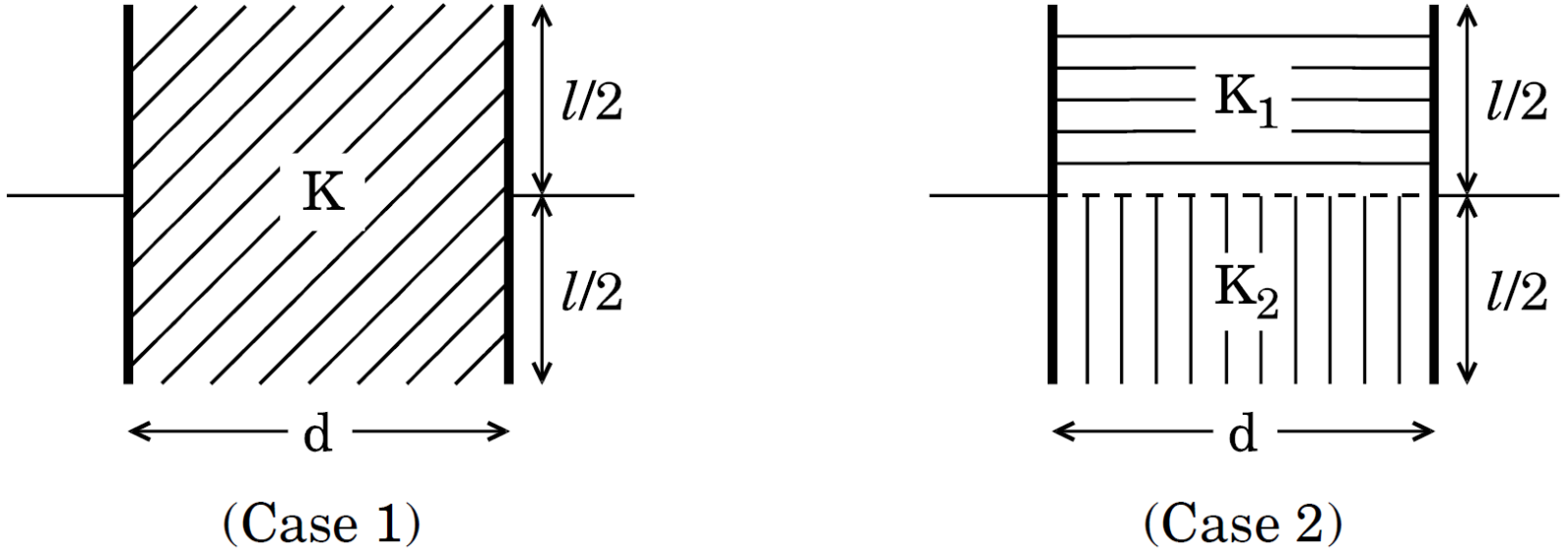
The space between the plates of a parallel plate capacitor is completely filled in two ways. In the first case, it is filled with a slab of dielectric constant K. In the second case, it is filled with two slabs of equal thickness and dielectric constants K1 and K2 respectively as shown in the figure. The capacitance of the capacitor is same in the two cases. Obtain the relationship between K, K1 and K2.

What is lens? State their types and draw their diagram.
Definitions needed to understand reflection from a Spherical mirror :
Two towers on top of two hills are 40 km apart. The line joining them passes 50 m above a hill halfway between the towers. What is the longest wavelength of radio waves, which can be sent between the towers without appreciable diffraction effects?
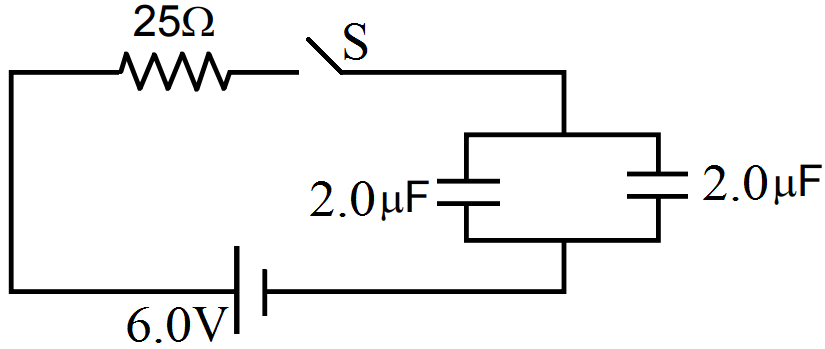
Find the charge on each of the capacitors 0.20ms after the switch S is closed in the figure.

Use Kirchhoff's rules to obtain conditions for the balance condition in a Wheatstone bridge.
Write the relation for the forces $\overrightarrow{F}$ acting on a charge carrier q moving with a velocity $\overrightarrow{V}$  through a magnetic field $\overrightarrow{B}$  in vector notation. Using this relation, deduce the conditions under which this force will be (1) maximum (2) minimum.
Two protons and two electrons are hanging freely at equal distances. Compare the repulsion force between proton and electron.
Write the number of significant digits in:
  1. 1001
  2. 100.1
  3. 100.10
  4. 0.001001