Question
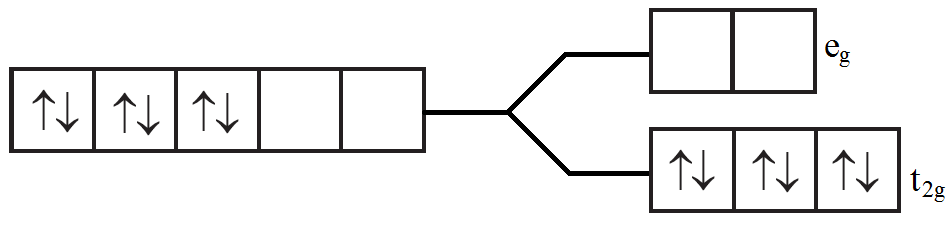
Using crystal field theory, draw energy level diagram, write electronic configuration of the central metal atom/ion and determine the magnetic moment value in the following:
  1. $[\text{CoF}_6]^{3-}, [\text{Co(H}_2\text{O})_6]^{2+}, [\text{Co(CN)}_6]^{3-}$
  2. $[\text{FeF}_6]^{3-}, [\text{Fe(H}_2\text{O})_6]^{2+}, [\text{Fe(CN})_6]^{4-}$
Answer

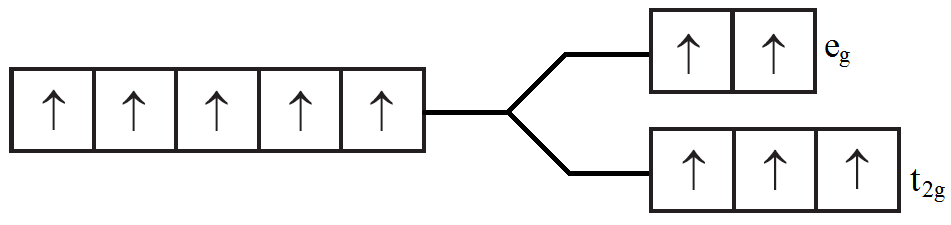
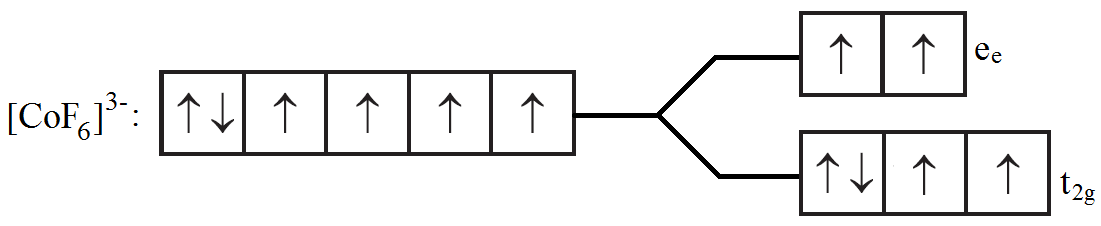
  1.  

$\text{Co}^{2+}=3\text{d}^7$
Number of unpaired electrons = 4
Magnetic moment
$=\sqrt{\text{n}(\text{n}+2)}=\sqrt{4(4+2)}=4.9\text{B.M.}$
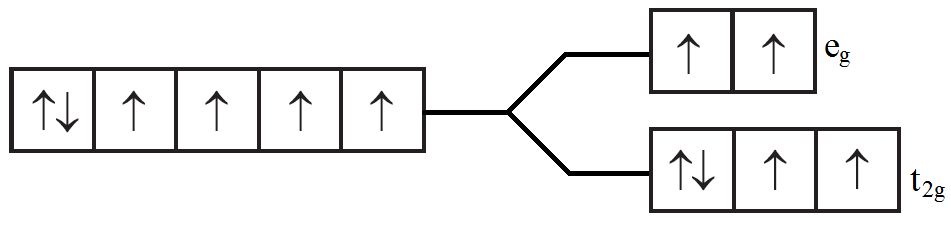
$[\text{Co(H}_2\text{O})_6]^{2+}:$

$\text{Co}^{2+}=3\text{d}^7$
Number of unpaired electrons = 3
Magnetic moment = $\sqrt{3(3+2)}=3.87\text{B.M.}$
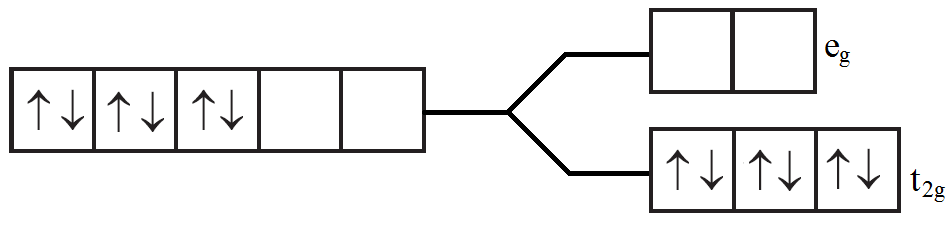
$[\text{Co(CN)}_6]^{3-}:$

$\text{Co}^{3+}=3\text{d}^6$
Number of unpaired electrons = 0
Diamagnetic.
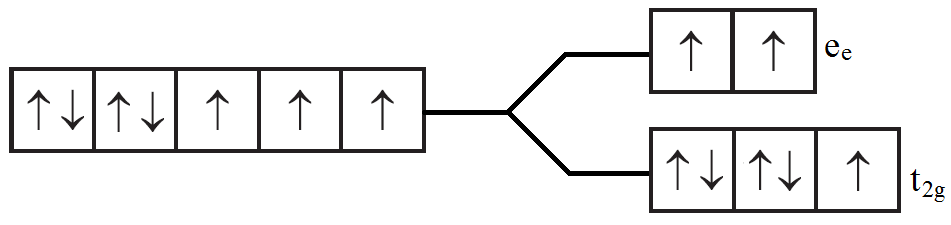
  1. $\text{FeF}^{3-}_6:$

$\text{Fe}^{3+}=3\text{d}^5$
Number of unpaired electrons = 5
Magnetic moment = $\sqrt{5(5+2})=5.92\text{B.M.}$
$[\text{Fe(H}_2\text{O})_6]^{2+}:$

$\text{Fe}^{2+}=3\text{d}^6$
Number of unpaired electrons = 4
Magnetic moment = $\sqrt{4(4+2})=4.9\text{B.M.}$
$[\text{Fe(CN)}_6]^{4-}:$

$\text{Fe}^{2+}=3\text{d}^6$
Diamagnetic.

Need a full question paper?

Generate a complete, print-ready paper with questions like this in minutes — across 16+ boards, with answer keys.

Start Generating Free

Similar questions

(a) Differentiate between
a. Nucleotide and Nucleoside
b. Amylose and Amylopectin
(b) Write a reaction which shows that all the carbon atoms in glucose are linked in a straight chain.
(c) Write two differences between DNA and RNA.
(d) Amino acids can be classified as $\alpha-, \beta-, \gamma-, \delta-$ and so on depending upon the relative position of the amino group with respect to the carboxyl group. Which type of amino acids forms a polypeptide chain in proteins?
(e) What are any two good sources of vitamin A?
(f) What is anomeric carbon?
(g) What is the difference between a glycosidic linkage and a peptide linkage?
Differentiate between $1^{\circ}, 2^{\circ}$ and $3^{\circ}$ alcohols by catalytic dehydrogenation.
Explain the following phenomena with the help of Henry’s law.
  1. Painful condition known as bends.
  2. Feeling of weakness and discomfort in breathing at high altitude.
Write short notes on the following :
(i) Kolbe's electrolytic reaction
(ii) Hell-Volhard-Zelinsky reaction
(iii) Esterification reaction
(iv) Decarboxylation reaction(v) Hunds-Diecker reaction
i. How will you convert:
a. Nitrobenzene to phenol,
b. Aniline to chlorobenzene
Magnetic properties of coordination compounds. Explain in detail.
Explain the effect of substitutents on the basic strength of aromatic amines.
Answer the following question:
$g$ of benzoic acid $(C_6H_5COOH)$ dissolved in $25g$ of benzene shows a depression in freezing point equal to $1.62K.$ Molal depression constant for benzene is $4.9K \ kg\ mol^{-1}.$ What is the percentage association of acid if it forms dimer in solution$?$
Explain the following terms with suitable examples:
(a) Cationic detergents, (b) Anionic detergents, (c) Neutral detergents.
Two elements A and B form compounds having formula AB2 and AB4. When dissolved in 20 g of benzene $\left( C _6 H _6\right), 1 g$ of $AB _2$ lowers the freezing point by 2.3 K whereas 1.0 g of AB4 lowers it by 1.3 K. The molar depression constant for benzene is 5.1 K kg mol-1. Calculate atomic masses of A and B.