Question
Explain the following terms with suitable examples:
(a) Cationic detergents, (b) Anionic detergents, (c) Neutral detergents.

Answer

Get the step-by-step solution for this question inside the Vidyadip app.

Get the answer in the app

Need a full question paper?

Generate a complete, print-ready paper with questions like this in minutes — across 16+ boards, with answer keys.
Start Generating Free

Similar questions

$FeSO_4$ solution mixed with $\left( NH _4\right)_2 SO _4$ solution in $1:1$ molar ratio gives the test of $Fe ^{2+}$ ion but $CuSO _4$ solution mixed with aqueous ammonia in $1: 4$ molar ratio does not give the test of $Cu ^{2+}$ ion. Explain why?
How would you distinguish among primary, secondary and tertiary alcohols?
Answer the following questions:
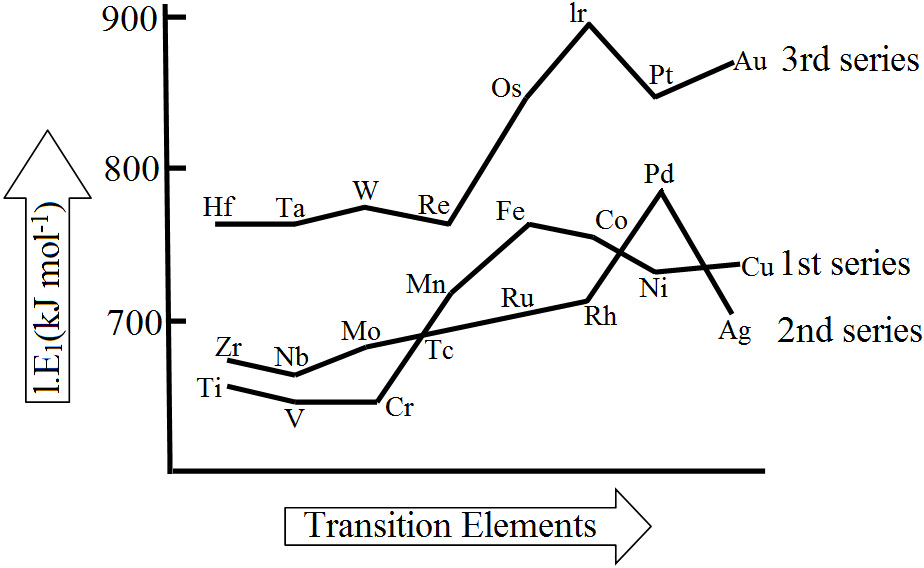
  1. The figure given alongside illustrates the first ionization enthalpies of first, second and third series of transition elements. Answer the question that follows:
  2. Which series amongst the first, second and third series of transition elements have the highest first ionization enthalpy and why?
  3. Separation of lanthanoid elements is difficult. Explain.
  4. $Sm^{2+}, Eu^{2+}$ and $Yb^{2+}$ ions in solutions are good reducing agents but an aqueous solution of $Ce^{4+}$ is a good oxidising agent. Why?
Write the formulas for the following coordination compounds:
a. Tetraammineaquachloridocobalt(III) chloride
b. Potassium tetrahydroxidozincate(II)
c. Potassium trioxalatoaluminate(III)
d. Dichloridobis(ethane-1, 2-diamine)cobalt(III)
e. Tetracarbonylnickel(0)
Describe the methods of studying various first order reactions with examples.
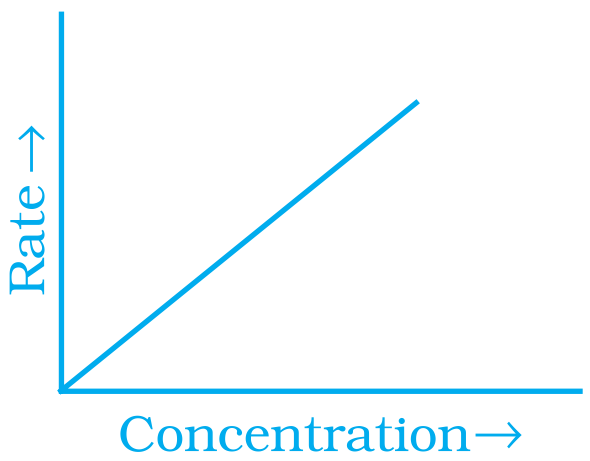
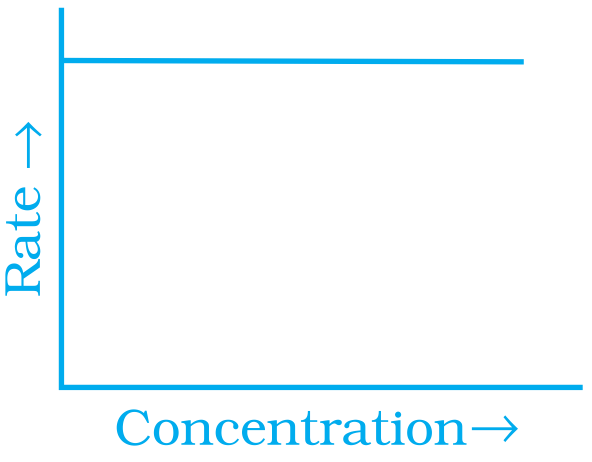
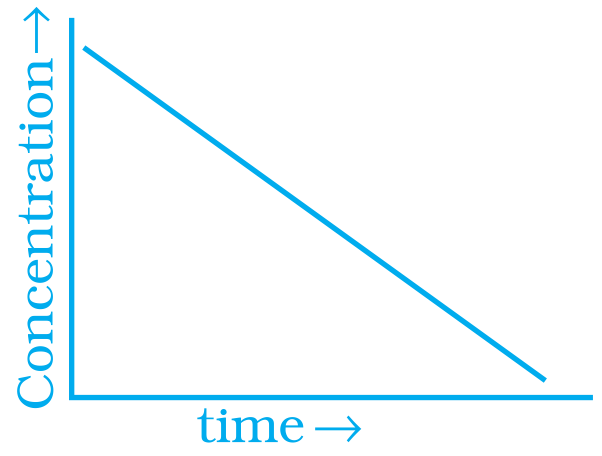
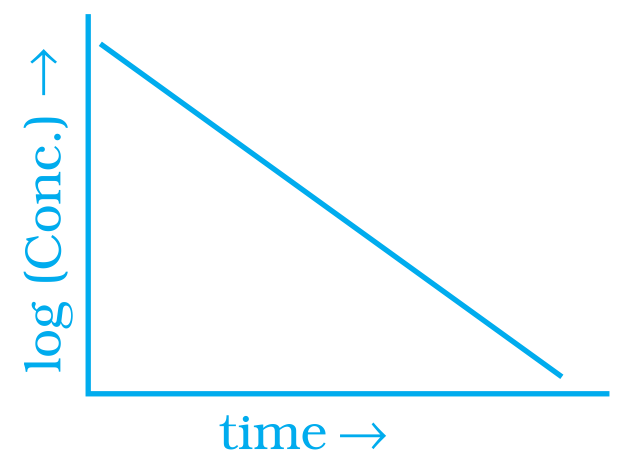
Match the graph given in Column $I$ with the order of reaction given in Column $II.$ More than one item in Column I may link to the same item of Column $II.$
 
Column I
 
Column II
$(i)$
 
 
$(ii)$
$(a)$ $I^{st}$ order
$(iii)$
$(b)$
Zero order
$(iv)$
   
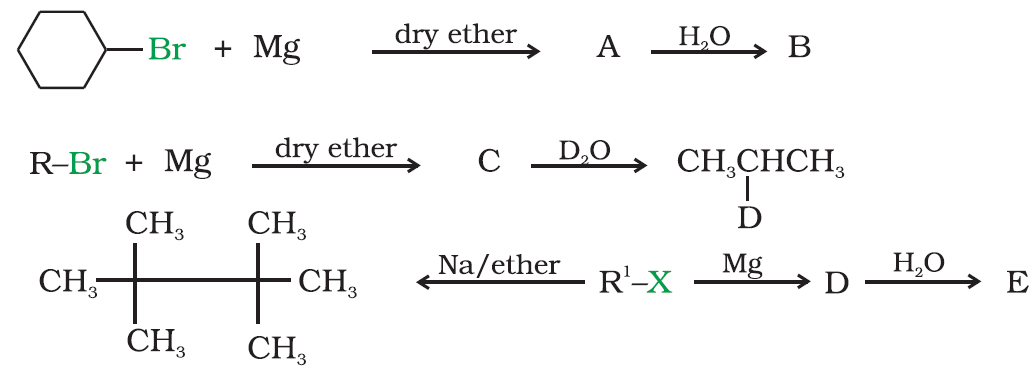
Identify $\text\{A, B, C, D, E, R\}$ and $R^1$ in the following:
  1. Define the following terms:
  1. Mole fraction.
  2. Ideal solution.
  1. $15.0\ g$ of an unknown molecular material is dissolved in $450\ g$ of water. The resulting solution freezes at $- 0.34^\circ C.$ What is the molar mass of the material?
$(K_f$ for water $= 1.86\ K \ kg\ mol^{–1}).$
Describe how does the enthalpy of reaction remain unchanged when a catalyst is used in the reaction.
State the reactions and reaction conditions for the following conversions:
i. Benzene diazonium chloride to nitrobenzene.
ii. Aniline to benzene diazonium chloride.
iii. Ethylamine to methylamine.