Question
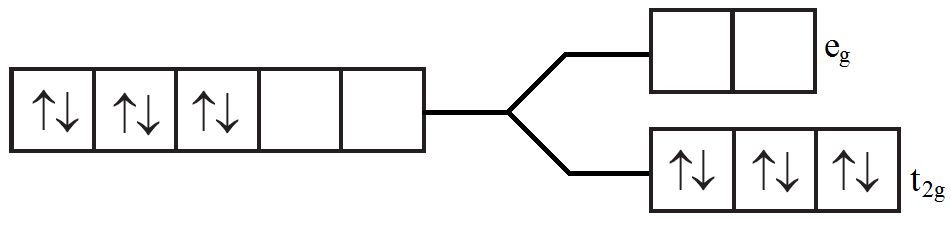
Using crystal field theory, draw energy level diagram, write electronic configuration of the central metal atom/ion and determine the magnetic moment value in the following:
  1. $[\text{CoF}_6]^{3-}, [\text{Co(H}_2\text{O})_6]^{2+}, [\text{Co(CN)}_6]^{3-}$
  2. $[\text{FeF}_6]^{3-}, [\text{Fe(H}_2\text{O})_6]^{2+}, [\text{Fe(CN})_6]^{4-}$
Answer

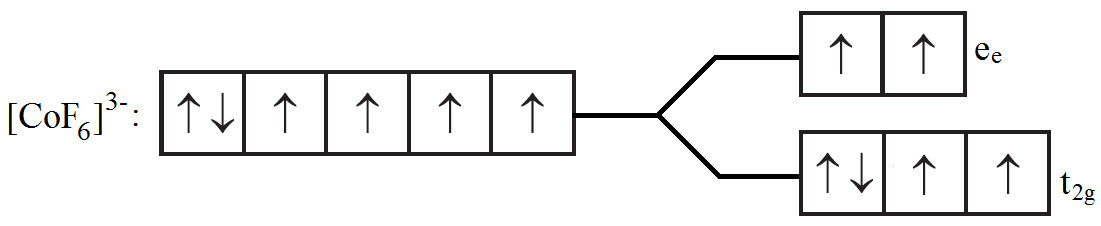
  1.  

$\text{Co}^{2+}=3\text{d}^7$
Number of unpaired electrons = 4
Magnetic moment
$=\sqrt{\text{n}(\text{n}+2)}=\sqrt{4(4+2)}=4.9\text{B.M.}$
$[\text{Co(H}_2\text{O})_6]^{2+}:$

$\text{Co}^{2+}=3\text{d}^7$
Number of unpaired electrons = 3
Magnetic moment = $\sqrt{3(3+2)}=3.87\text{B.M.}$
$[\text{Co(CN)}_6]^{3-}:$

$\text{Co}^{3+}=3\text{d}^6$
Number of unpaired electrons = 0
Diamagnetic.
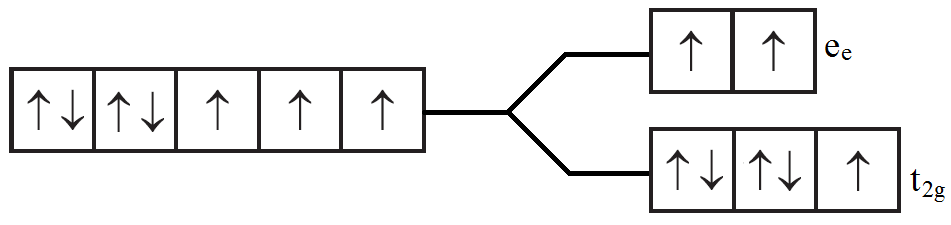
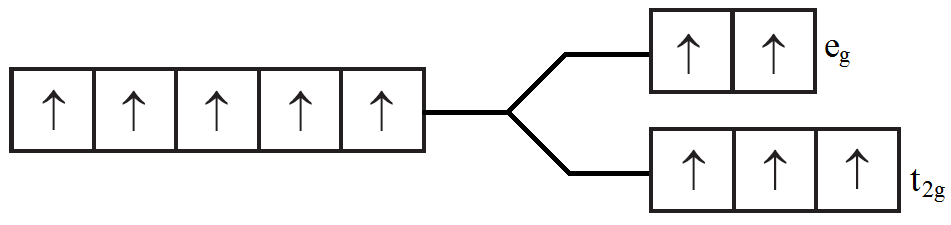
  1. $\text{FeF}^{3-}_6:$

$\text{Fe}^{3+}=3\text{d}^5$
Number of unpaired electrons = 5
Magnetic moment = $\sqrt{5(5+2})=5.92\text{B.M.}$
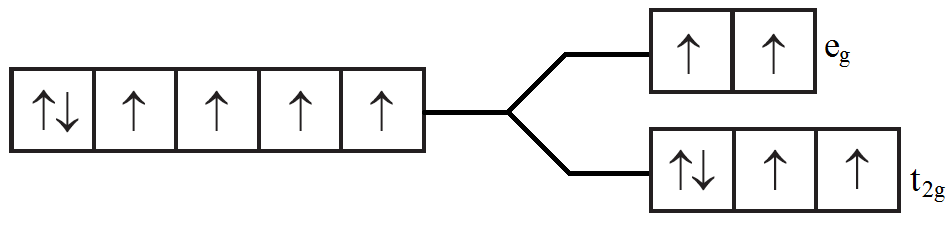
$[\text{Fe(H}_2\text{O})_6]^{2+}:$

$\text{Fe}^{2+}=3\text{d}^6$
Number of unpaired electrons = 4
Magnetic moment = $\sqrt{4(4+2})=4.9\text{B.M.}$
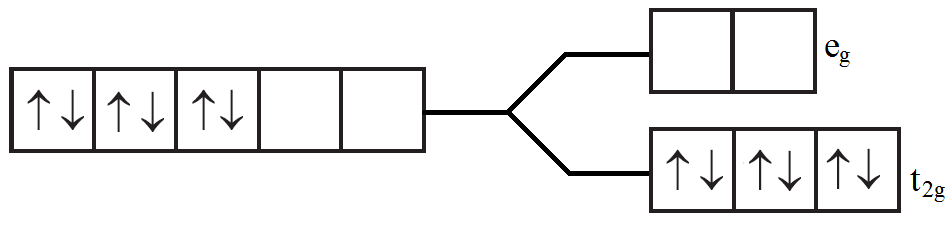
$[\text{Fe(CN)}_6]^{4-}:$

$\text{Fe}^{2+}=3\text{d}^6$
Diamagnetic.

Need a full question paper?

Generate a complete, print-ready paper with questions like this in minutes — across 16+ boards, with answer keys.

Start Generating Free

Similar questions

The experimental data for decomposition of $N_2O_5 [2N_2O_5 \rightarrow 4NO_2 + O_2]$ in gas phase at $318K$ are given below:
$t/s$ $0$ $400$ $800$ $1200$ $1600$ $2000$ $2400$ $2800$ $3200$
$10^2 \times [N_2O_5]/mol L^{-1}$ $1.63$ $1.36$ $1.14$ $0.93$ $0.78$ $0.64$ $0.53$ $0.43$ $0.35$
  1. Plot $[N_2O_5]$ against t.
  2. Find the half-life period for the reaction.
  3. Draw a graph between $\log[N_2O_5]$ and $t.$
  4. What is the rate law?
  5. Calculate the rate constant.
  6. Calculate the half-life period from k and compare it with $(ii).$
Describe the methods of studying various first order reactions with examples.
Attempt any five of the following:
$(a)$ What are Purines and Pyrimidines? Name the purines and Pyrimidines present in $ \text{DNA}$ and $ \text{RNA}$ nucleic Acids.
$(b)$ Write the full forms of $ \text{DNA}$ and $ \text{RNA}$
$(c)$ Name the vitamin whose deficiency causes convulsions.
$(d)$ Which vitamin $B$ group can be stored in our body?
$(e) (i).$ What is the difference between a nucleoside and nucleotide?
$(ii).$ Write one difference between $a-$helix and $\beta-$pleated sheet structures of protein.
$(f)$ What are nucleic acids? Why two strands in $ \text{DNA}$ are not identical but are complementary?
$(g)$ Some enzymes are named after the reaction, where they are used. What name is given to the class of enzymes which catalyse the oxidation of one substrate with simultaneous reduction of another substrate?
  1. Complete the following chemical equations:
  1. $ \text{MnO}_{4}^{-}\text{(aq)}+\text{S}_{2}\text{O}_{4}\text{(aq)}+\text{H}_{2}\text{O}\text{(l)}\rightarrow$
  2. $\text{Cr}_{2}\text{O}_{4}^{2-}\text{(aq)}+\text{Fe}^{2+}\text{(aq)}+\text{H}^{+}\text{(aq)}\rightarrow$
  1. Explain the following observations:
  1. $La^{3+} (Z = 57)$ and $Lu^{3+} (Z = 71)$ do not show any colour in solutions.
  2. Among the divalent cations in the first series of transition elements, manganese exhibits the maximum paramagnetism.
  3. $Cu^+$ ion is not known in aqueous solutions.
  1. Give reasons:
  1. $H_3PO_3$_ undergoes disproportionation reaction but $H_3PO_4$_ does not.
  2. When $Cl_2$_ reacts with excess of $F_2, ClF_3$_ is formed and not $FCl_3.$
  3. Dioxygen is a gas while Sulphur is a solid at room temperature.
  1. Draw the structures of the following:
  1. $XeF_4$
  2. $HClO_3$
The rate constant for the decomposition of $N_2O_5$ at various temperatures is given below:
$T/^\circ C$ $0$ $20$ $40$ $60$ $80$
$105 \times k/s-1$ $0.0787$ $1.70$ $25.7$ $178$ $2140$
Draw a graph between ln $k$ and $1/T$ and calculate the values of $A$ and $E_a$. Predict the rate constant at $30^\circ$ and $50^\circ C.$
An aromatic compound ‘A’ on treatment with $CHCl_3 / KOH$ gives two compounds ‘B’ and ‘C’. Both B and C give the same product ‘D’ when distilled with zinc dust. Oxidation of D gives E having molecular formula $C_7H_6O_2$. The sodium salt of E on heating with sodalime gives F which may also be obtained by distilling A with zinc dust. Identify A to F.
  1. Account for the following:
  1. Thermal stability of water is much higher than that of $H_2S$.
  2. Anhydrous aluminium chloride acts as a catalyst.
  3. White phosphorus is more reactive than red phosphorus.
  1. Draw the structures of (i) $H_3PO_3$​​​​​​​ and (ii) $XeOF_4$​​​​​​​.
How are different aromatic compounds synthesized by benzene diazonium chloride? Explain with examples.
i. How will you convert:
a. Nitrobenzene to phenol,
b. Aniline to chlorobenzene