Question
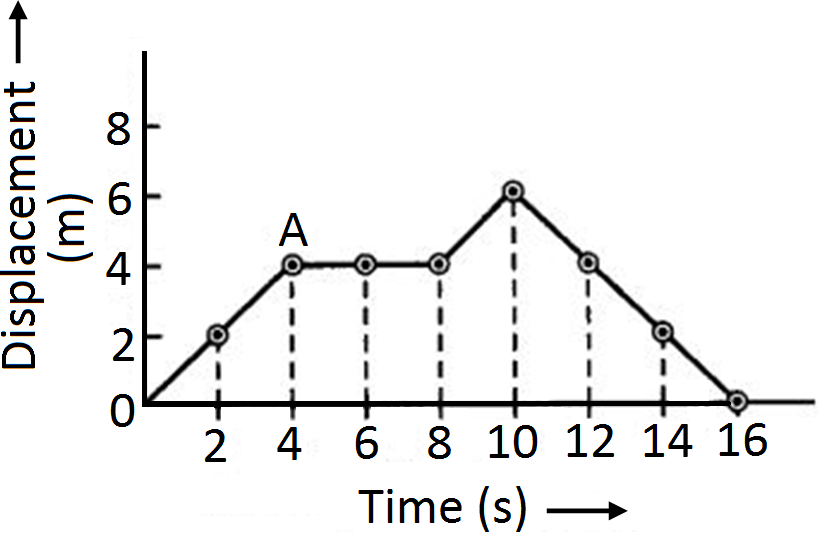
Using following data, draw time-displacement graph for a moving object:
Time (s)
0
2
4
6
8
10
12
14
16
Displacement (m)
0
2
4
4
4
6
4
2
0
 Use this graph to find average velocity for first 4s, for next 4s and for last 6s.

Answer

Therefore, displacement-time graph is shown in figure.
Average velocity for first $4\text{s}=\frac{\text{Change in displacement}}{\text{Total time takan}}$$\text{v}=\frac{4-0}{4-0}=\frac{4\text{m}}{4\text{s}}=1\text{ms}^{-1}$
Average velocity for next 4s (i.e., in the interval of 4s to 8s), $\text{v}=\frac{4-4}{8-4}=\frac{0}{4}=0$ Average velocity for last $6\text{s}=\frac{(0-6)\text{m}}{(16-10)\text{s}}=\Big(\frac{-6}{6}\Big)=1\text{ms}^{-1}$

Need a full question paper?

Generate a complete, print-ready paper with questions like this in minutes — across 16+ boards, with answer keys.

Start Generating Free

Similar questions

Draw a flow sheet diagram showing the separation of various components of a mixture containing camphor, sand and iron filings.
What are the features and drawbacks of Rutherford’s nuclear model of an atom?
What is simple tissue? Classify and explain its Different types with suitable diagram.
State and explain Kepler’s laws of planetary motion. Draw diagrams to illustrate these laws.
What is artificial insemination? Give its uses.
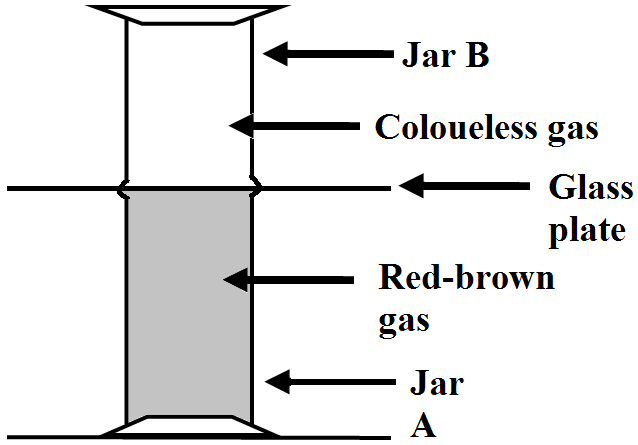
Look at the diagram on the right side. Jar A contains are d-brown gas whereas Jar B contains a colourless gas. The two gas jars are separated by a glass plate placed between them:
  1. What will happen when the glass plate between the two jars is pulled away?
  2. What name is given to the phenomenon which takes place?
  3. Name the brown gas which could be in jar A.
  4. Which is the colorless gas most likely to be present in jar B?
  5. Name one coloured solid and one colourless liquid which can show the same phenomenon.
If the distance between two masses is increased by a factor of $5,$ by what factor would the mass of one of them have to be altered to maintain the same gravitational force? Would this be an increase or decrease in the mass?
Give the formulate of the compounds formed from the following sets of elements:
  1. Calcium and fluorine.
  2. Hydrogen and sulphur.
  3. Nitrogen and hydrogen.
  4. Carbon and chlorine.
  5. Sodium and oxygen.
  6. Carbon and oxygen.
There is a large group of materials P which can be divided into three groups Q, R, and S on the basis of their properties. The substances belonging to group Q can be solids, liquids or gases. The solids belonging to group Q are usually electrical insulators. Most of the substances of group R are solids which are good conductors of electricity. The substances belonging to group S are neither insulators like Q nor good conductors like R. The properties of S are intermediate between those of Q and R.
  1. What could the group of materials P be?
  2. Name the substances Q. Give two examples of such substances.
  3. Name the substances R. Write two examples of such substances.
  4. Name the substances S. Give two examples of such substances.
  5. Out of Q, R and S, which substances are malleable and ductile?
What is feed? What are different type of feed? How is it differ with respect to age and functions?