Question
  1. Using Gauss Theorem show mathematically that for any point outside the shell, the field due to a uniformly charged spherical shell is same as the entire charge on the shell, is concentrated at the centre.
  2. Why do you expect the electric field inside the shell to be zero according to this theorem?
OR
A thin conducting spherical shell of radius $R$ has charge $Q$ spread uniformly over its surface. Using Gauss’s theorem, derive an expression for the electric field at a point outside the shell.
Draw a graph of electric field $E(r)$ with distance r from the centre of the shell for $0\leq\text{r}\le\infty.$
OR
Find the electric field intensity due to a uniformly charged spherical shell at a point $(i)$ outside the shell and $(ii)$ inside the shell. Plot the graph of electric field with distance from the centre of the shell.
OR
Using Gauss’s law obtain the expression for the electric field due to a uniformly charged thin spherical shell of radius $R$ at a point outside the shell. Draw a graph showing the variation of electric field with r, for $r > R$ and $r < R.$
Answer

Image
  1. Electric field intensity at a point outside a uniformly charged thin spherical shell: Consider a uniformly charged thin spherical shell of radius $R$ carrying charge $Q$. To find the electric field outside the shell, we consider a spherical Gaussian surface of radius $r (>R)$, concentric with given shell. If $\vec{\text{E}}$ is electric field outside the shell, then by symmetry electric field strength has same magnitude $E_0$_ on the Gaussian surface and is directed radially outward. Also the directions of normal at each point is radially outward, so angle between $\vec{\text{E}}_\text{i}$ and $\vec{\text{dS}}$ is zero at each point. Hence, electric flux through Gaussian surface.
$\oint\text{S}=\vec{\text{E}}_0.\vec{\text{dS}}$
$\oint=\text{E}_0\text{dS}\cos0=\text{E}_0.4\pi\text{r}^2$
Now, Gaussian surface is outside the given charged shell, so charge enclosed by Gaussian surface is $Q.$
Hence, by Gauss’s theorem,
$\oint\text{S}=\vec{\text{E}}_0.\vec{\text{dS}}=\frac{1}{\epsilon_0}\times\text{charged enclosed}$
$\Rightarrow\ \text{E}_0.4\pi\text{r}^2=\frac{1}{\epsilon_0}\times\text{Q}$
$\Rightarrow\ \text{E}_0=\frac{1}{4\pi\epsilon_0}\frac{\text{Q}}{\text{r}^2}$
Thus, electric field outside a charged thin spherical shell is the same as if the whole charge $Q$ is concentrated at the centre.
If $\sigma$ is the surface charge density of the spherical shell, then
$\text{Q}=4\pi\text{R}^2\sigma$ coulomb
$\therefore\ \text{E}_0=\frac{1}{4\pi\epsilon_0}\frac{4\pi\text{R}^2\sigma}{\text{r}^2}=\frac{\text{R}^2\sigma}{\epsilon_0\text{r}^2}$
Image
  1. Electric field inside the shell (hollow charged conducting sphere): The charge resides on the surface of a conductor. Thus a hollow charged conductor is equivalent to a charged spherical shell. To find the electric field inside the shell, we consider a spherical Gaussian surface of radius $r (< R)$ concentric with the given shell. If $\vec{\text{E}}$ is the electric field inside the shell, then by symmetry electric field strength has the same magnitude E_i on the Gaussian surface and is directed radially outward. Also the directions of normal at each point is radially outward, so angle between $\vec{\text{E}}_\text{i}$ and $\vec{\text{dS}}$ is zero at each point.
Hence, electric flux through Gaussian surface,
$=\int\limits_\text{S}\vec{\text{E}}_{\text{i}}.\vec{\text{dS}}=\int\text{E}_\text{i}.\text{dS}\cos0=\text{E}_\text{i}.4\pi\text{r}^2$
Now, Gaussian surface is inside the given charged shell, so charge enclosed by Gaussian surface is zero.
Hence, by Gauss’s theorem,
$\int\limits_\text{S}\vec{\text{E}}_\text{i}.\vec{\text{dS}}=\frac{1}{\epsilon_0}\times\text{charged enclosed}$
$\Rightarrow\ \text{E}_\text{i}4\pi\text{r}^2=\frac{1}{\epsilon_0}\times0\Rightarrow\ \text{E}_\text{i}=0$
Image
Thus, electric field at each point inside a charged thin spherical shell is zero. The graph is shown in fig.

Need a full question paper?

Generate a complete, print-ready paper with questions like this in minutes — across 16+ boards, with answer keys.

Start Generating Free

Similar questions

Two charges of$5 \times 10^{-8} C$ and $-3 \times 10^{-8}$ are located at a distance of 16 cm apart. At what point on the line joining the two charges is the electric potential zero? Take the potential at infinity to be zero.
Image
A particle slides on the surface of a fixed smooth sphere starting from the topmost point. Find the angle rotated by the radius through the particle, when it leaves contact with the sphere.
Radiations of frequency $10^{15}Hz$ are incident on two photosensitive surfaces $A$ and $B.$ Following observations are recorded:
Surface $A:$ No photoemission takes place.
Surface $B:$ Photoemission takes place but photoelectrons have zero energy.
Explain the above observations on the basis of Einstein’s photoelectric equation. How will the observation with surface $B$ change when wavelength of incident light is decreased?
Describe Davisson and Germer’s experiment to demonstrate the wave nature of electrons. Draw a labelled diagram of apparatus used.
Explain principle of Rutherford and Soddy in relation with redioactive decay.
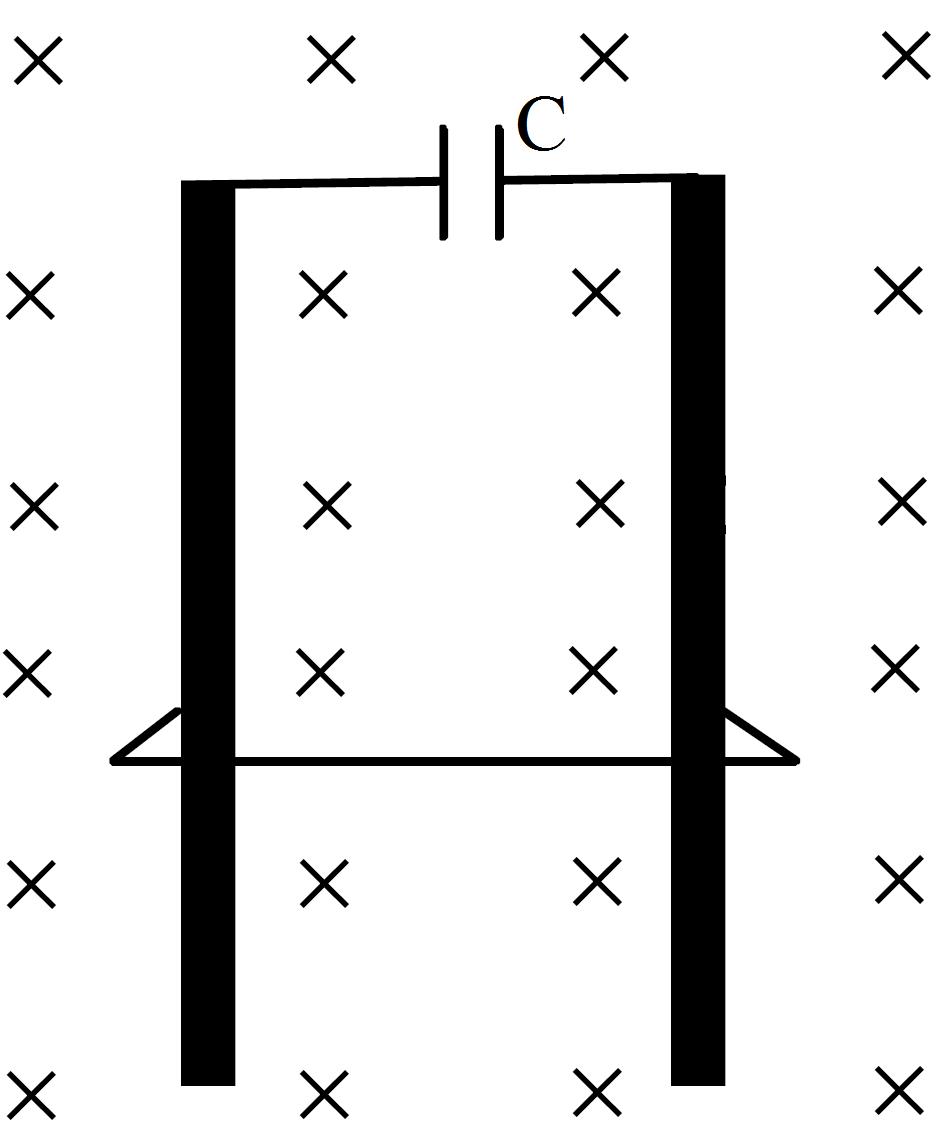
A wire of mass m and length l can slide freely on a pair of smooth, vertical rails (figure). A magnetic field B exists in the region in the direction perpendicular to the plane of the rails. The rails are connected at the top end by a capacitor of capacitance C. Find the acceleration of the wire neglecting any electric resistance.
A compound microscope consists of an objective of focal length $1\ cm$ and an eyepiece of focal length $5\ cm$. An object is placed at a distance of $0.5\ cm$ from the objective. What should be the separation between the lenses so that the microscope projects an inverted real image of the object on a screen $30\ cm$ behind the eyepiece?
Solve the previous problem if the pulley has a moment of inertia I about its axis and the string does not slip over it.
Can the bulb of a thermometer be made of an adiabatic wall?
The given figure shows a capacitor made of two circular plates each of radius 12 cm, and separated by 5.0 cm. The capacitor is being charged by an external source (not shown in the figure). The charging current is constant and equal to 0.15 A.
(a) Calculate the capacitance and the rate of change of potential difference between the plates.
(b) Obtain the displacement current across the plates.
(c) Is Kirchhoff's first rule (junction rule) valid at each plate of the capacitor? Explain.
Image