Question
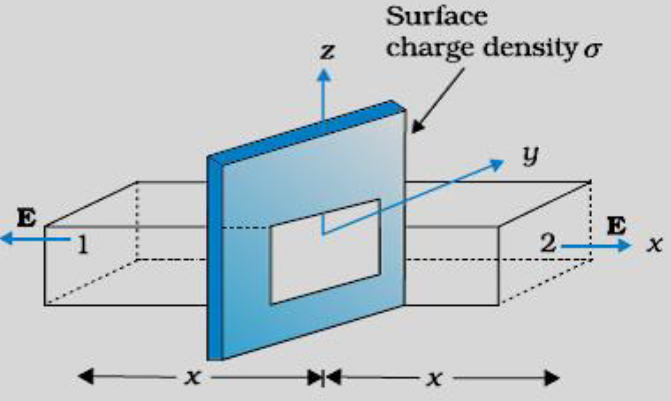
Using Gauss’s law in electrostatics, deduce an expression for electric field intensity due to a uniformly charged infinite plane sheet. If another identical sheet is placed parallel to it, show that there is no electric field in the region between the two sheets.
Answer

By Gauss’s law $ \oint \overrightarrow{E}.\overrightarrow{ds}=\frac{q}{\epsilon_0}$
$\therefore{2{\text{EA}}}=\frac{\sigma{\text{A}}}{{\epsilon_0}}$
$\therefore\text{E}=\frac{\sigma}{2\epsilon_0}\text{ }\text{or}\frac{\sigma}{2\epsilon_0}\text{A}$
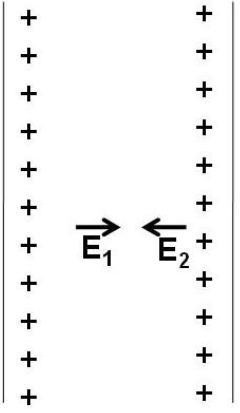
Electric field between two identical charged sheets $\because$  Both the sheets have same charge density, their electric fields will be equal and opposite in the region between the two sheets.
Hence the net field is zero. 
Alternate Answer
$\text{E}_1=\frac{\sigma}{2\epsilon_0}$
$\text{E}_2=-\frac{\sigma}{2\epsilon_0}$
Resultant electric field between the plates $ = E_1 + E_2\frac{\sigma}{2\epsilon_0}-\frac{\sigma}{2\epsilon_0}=0$

Need a full question paper?

Generate a complete, print-ready paper with questions like this in minutes — across 16+ boards, with answer keys.

Start Generating Free

Similar questions

Sketch a graph showing the variation of fringe width versus the distance of the screen from the plane of the slits (keeping other parameters same) in Young’s double slit experiment. What information can one obtain from the slope of this graph?
If one of the two electrons of a $H_2$ molecule is removed, we get a hydrogen molecular ion $\text{H}^+_2​.$ In the ground state of an $\text{H}^+_2​,$ the two protons are separated by roughly $1.5 \mathring A ,$ and the electron is roughly $1 \mathring A$ from each proton. Determine the potential energy of the system. Specify your choice of the zero of potential energy.
In one-dimensional elastic collision of equal masses, the velocities are interchanged. Can velocities in a onedimensional collision be interchanged if the masses are not equal?
An amount $Q$ of heat is added to a monatomic ideal gas in a process in which the gas performs a work $\frac{\text{Q}}{2}$ on its surrounding. Find the molar heat capacity for the process.
Suppose the rod in the previous problem has a mass of $1\ kg$ distributed uniformly over its length:
  1. Find the initial angular acceleration of the rod.
  2. Find the tension in the supports to the blocks of mass $2\ kg$ and $5\ kg.$
Suppose the spheres $A$ and $B$ in Exercise $1.12$ have identical sizes. A third sphere of the same size but uncharged is brought in contact with the first, then brought in contact with the second, and finally removed from both. What is the new force of repulsion between $A$ and $B$?
Explain how radioactive nuclei can emit $\beta-$particles even though atomic nuclei do not contain these particles? Hence explain why the mass number of radioactive nuclide does not change during $\beta-$decay?
Two blocks of equal mass m are tied to each other through a light string. One of the blocks is pulled along the line joining them with a constant force F. Find the tension in the string joining the blocks.
By how much would the stopping potential for a given photosensitive surface go up if the frequency of the incident radiations were to be increased from $4 \times 10^{15}\ Hz$ to $8 \times 10^{15}\ Hz$?
Given $h = 6.4 \times 10^{-34} J-s, e = 1.6 \times 10^{-19}C$ and $c = 3 \times 10^8 ms^{-1}$.
Explain with example, whether the neutron-proton ratio in a nucleus increases or decreases due to $\beta-$decay.