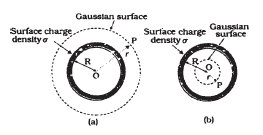
Derivation: $\text{E}\times4\pi\text{r}^{2} =\frac{\sigma}{\varepsilon_{\circ}}4\pi\text{R}^{2}$
$\therefore \text{E} = \frac{\sigma\text{R}^{2}}{\varepsilon_{\circ}\text{r}^{2}}$
where $\text{q} = 4\pi\text{R}^{2}\sigma$ is the total charge on the spherical shell. Electrostatic field is zero, since total charge inside the shell is zero or charge reside on the surface of the shell.
Generate a complete, print-ready paper with questions like this in minutes — across 16+ boards, with answer keys.
$\rho\text{(r)}=\text{kr for r}\leq\text{R}$
$=0\text{ for f}>\text{R}.$
Find the electric field at all points r.A parallel plate capacitor, each with plate area A and separation d, is charged to a potential difference V. The battery used to charge it is then disconnected. A dielectric slab of thickness d and dielectric constant K is now placed between the plates. What change, if any, will take place in.