Question
Using lens maker's formula obtain the equation of lens.

Answer


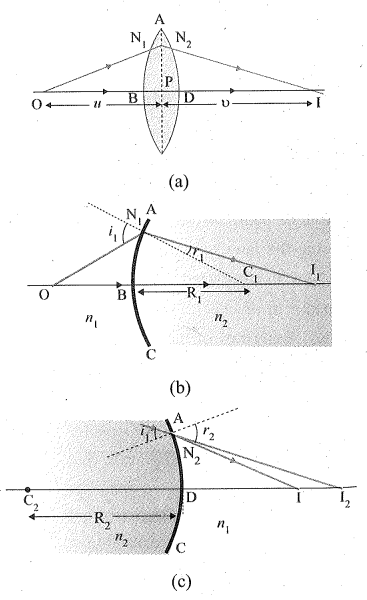
Image
→For refraction at two spherical surfaces of lens,
$\begin{aligned}& \frac{n_1}{ OB }+\frac{n_1}{ DI }=\left(n_2-n_1\right)\left(\frac{1}{ BC _1}+\frac{1}{ DC _2}\right) \\\therefore \quad & n_1\left(\frac{1}{ OB }+\frac{1}{ DI }\right)=\left(n_2-n_1\right)\left(\frac{1}{ BC _1}+\frac{1}{ DC _2}\right) \\\therefore \quad & \frac{1}{ OB }+\frac{1}{ DI }=\left(n_{21}-1\right)\left(\frac{1}{ BC _1}+\frac{1}{ DC _2}\right)\end{aligned}$
→using sign convention,
$OB =-u, DI =v, BC _1= R _1 \text { and } DC _2=- R _2.$
Substituting these values in above equation,
$\therefore-\frac{1}{u}+\frac{1}{v}=\left(n_{21}-1\right)\left(\frac{1}{ R _1}-\frac{1}{ R _2}\right)$            ...(1)
→lens maker's formula,
$\therefore \quad \frac{1}{f}=\left(n_{21}-1\right)\left(\frac{1}{ R _1}-\frac{1}{ R _2}\right)$              ...(2)
→Comparing equation (1) and (2),
$\therefore \frac{1}{v}-\frac{1}{u}=\frac{1}{f}$
→This equation is known as lens equation.
→This equation is true for both convex and concave lens.

Need a full question paper?

Generate a complete, print-ready paper with questions like this in minutes — across 16+ boards, with answer keys.
Start Generating Free

Similar questions

A magnifying glass is a converging lens placed close to the eye. A farsighted person uses spectacles having converging lenses. Compare the functions of a converging lens used as a magnifying glass and as spectacles.
The magnifying power of a simple microscope is given by $1+\frac{\text{D}}{\text{f}},$ where D is the least distance for clear vision. For farsighted persons, D is greater than the usual. Does it mean that the magnifying power of a simple microscope is greater for a farsighted person as compared to a normal person? Does it mean that a farsighted person can see an insect more clearly under a microscope than a normal person?
What is the parallel connection of cells ? Derive the formula for equivalent $\text{e m f}$ and equivalent internal resistance for parallel connection of cell.
A simple pendulum consists of a 50cm long string connected to a 100g ball. The ball is pulled aside so that the string makes an angle of 37° with the vertical and is then released. Find the tension in the string when the bob is at its lowest position.
At what distance should two charges, each equal to $1C,$ be placed so that the force between them equals your weight?
When a photon is emitted by a hydrogen atom, the photon carries a momentum with it. $(a)$ Calculate the momentum carries by the photon when a hydrogen atom emits light of wavelength $656.3\ nm. (b)$ With what speed does the atom recoil during this transition? Take the mass of the hydrogen atom $= 1.67 \times 10^{-27}kg. (c)$ Find the kinetic energy of recoil of the atom.
In a $p-n$ junction, the depletion region is $400\ nm$ wide and an electric field of $5 \times 10^5\ V/m$ exists in it.
  1. Find the height of the potential barrier.
  2. What should be the minimum kinetic energy of a conduction electron which can diffuse from the $n-$side to the $p-$side?
(a) When a telescope is turned upside down and looked at the objective, it appears very small, why?
(b) Why does this not happen in a microscope?
Electrons are continuously in motion within a conductor but there is no current in it unless some source of potential is applied across its ends. Give reason.
Consider a uniform electric field $E = 3 \times 10^3 î N/C$.
  1. What is the flux of this field through a square of $10 \ cm$ on a side whose plane is parallel to the $yz$ plane?
  2. What is the flux through the same square if the normal to its plane makes a $60^\circ $ angle with the $x-$ axis ?