Question
Using ruler and compasses, construct the following angle:
67.5°

Answer

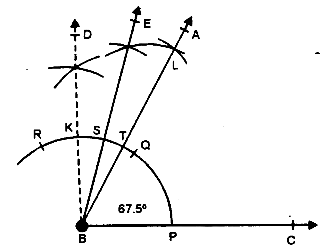
Steps of Construction:
(i) Draw a line segment $BC$.
(ii) With centre $B$ and some suitable radius, draw an arc meeting $B C$ at $P$.
(iii) With centre $P$ and with the same radius, cut $\operatorname{arcs} P Q$ and then $Q R$.
(iv) Bisect arc QR at $K$ and again bisect arc $Q K$ at $S$.
(v) Bisect again arc SQ at T.
(vi) Join $B T$ and produce it to $A$.
Then $\angle ABC =67 \frac{1}{2}^{\circ}$ or $67.5^{\circ}$

Need a full question paper?

Generate a complete, print-ready paper with questions like this in minutes — across 16+ boards, with answer keys.
Start Generating Free

Similar questions

Simplify: $\mathrm{p}^2-\left[\mathrm{x}^2-\left\{\mathrm{x}^2-\left(\mathrm{q}^2-\overline{\mathrm{x}^2-\mathrm{q}^2}\right)-2 \mathrm{y}^2\right\}\right]$
State, whether the pairs of triangles given in the following figures are congruent or not:
Δ ABC in which AB = 2 cm, BC = 3.5 cm and ∠C = 80° and Δ DEF in which DE = 2 cm, DF = 3.5 cm and ∠D = 80°.
Reduce to a single fraction:
$\frac{2}{3}-\frac{3}{5}+3-\frac{1}{5}$
The radius of two circles are $20 \mathrm{~cm}$ and $13 \mathrm{~cm}$. Find the difference between their circumferences. (Take $\left.\pi=\frac{22}{7}\right)$
Simplify: $5 \frac{3}{4}-\frac{3}{7} \times 15 \frac{3}{4}+2 \frac{2}{35} \div 1 \frac{11}{25}$
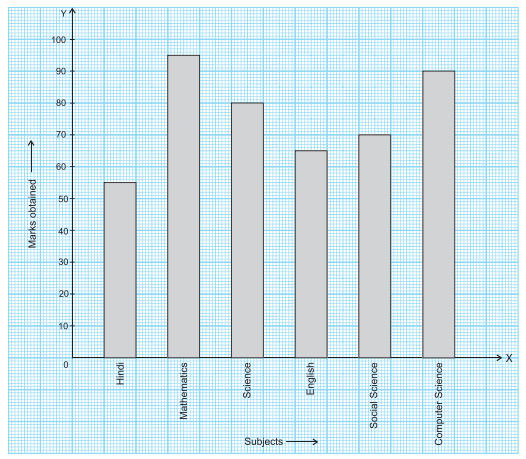
Read the given bar graph and answer the questions that follow :
Image
(i) What information is represented by the bar graph?
(ii) How many marks were obtained in English?
(iii) In which subject least marks were obtained?
(iv) What was the total marks obtained in all the subjects together?
A T.V. set is sold for Rs. 6800 at a loss of 15%. Find
(i)cost price of the T.V. set.
(ii)new selling price of it, in order to gain 12%.
One angle of a triangle is 60°. The other two angles are in the ratio of 5: 7. Find the two angles.
Put the given fraction in ascending order by making denominator equal:
$\frac{5}{6}, \frac{7}{8}, \frac{11}{12} \text { and } \frac{3}{10}$
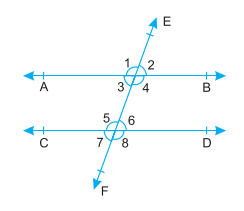
Two lines $A B$ and $C D$ are cut by a transversal $E F$, as shown in the figure. Identify the given pair of angles as adjacent angles, vertically opposite angles, alternate angles, corresponding angles or co-interior angles.
Image
(i) $\angle 6$ and $\angle 7$
(ii) $\angle 3$ and $\angle 4$
(iii) $\angle 4$ and $\angle 8$
(iv) $\angle 1$ and $\angle 5$
(v) $\angle 3$ and $\angle 5$
(vi) $\angle 2$ and $\angle 4$
(vii) $\angle 4$ and $\angle 5$
(viii) $\angle 2$ and $\angle 7$
(ix) $\angle 3$ and $\angle 6$
(x) $\angle 4$ and $\angle 6$
(xi) $\angle 2$ and $\angle 6$
(xii) $\angle 1$ and $\angle 4$