Question
Using the distance formula, show taht the given points are collinear:
(-1, -1), (2, 3) and (8, 11)

Answer

Let A(-1, -1), B(2, 3) and C(8, 11) be the given points
Then,
$\text{AB}=\sqrt{(2-1)^2+(3+1)^2}=\sqrt{(3)^2+(4)^2}$
$=\sqrt{9+16}=\sqrt{25}=5\text{ units}$
$\text{BC}=\sqrt{(8-2)^2+(11-3)^2}=\sqrt{(6)^2+(8)^2}$
$=\sqrt{36+64}=\sqrt{100}=10\text{ units}$
$\text{AC}=\sqrt{(8+1)^2+(11+1)^2}=\sqrt{(9)^2+(12)^2}$
$=\sqrt{81+144}=\sqrt{225}=15\text{ units}$
$\therefore\text{AB}+\text{AC}=5+10=15\text{ units}=\text{BC}$
$\Rightarrow\text{AB}+\text{AC}=\text{BC}$
Hence, the given points are collinear.

Need a full question paper?

Generate a complete, print-ready paper with questions like this in minutes — across 16+ boards, with answer keys.

Start Generating Free

Similar questions

Draw a line segment of length $7.6\ cm$ and divide it in the ratio $5 : 8$. Measure the two parts.
Compute the mode from the following series:
Size
45-55
55-65
65-75
75-85
85-95
95-105
105-115
Frequency
7
12
17
30
32
6
10
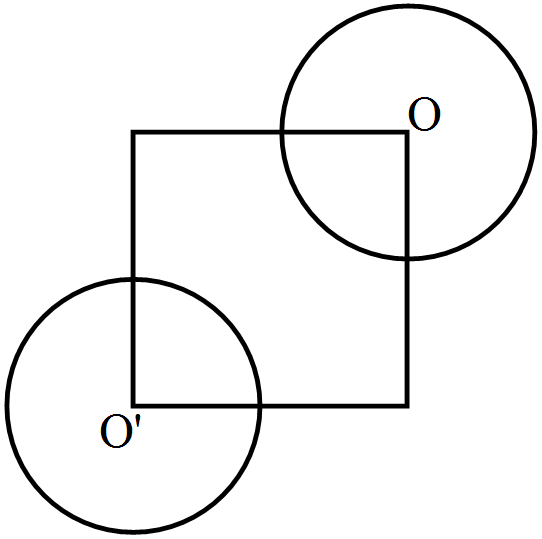
In the given figure, the side of suare is 28cm and radius of each circle is half of the length of the side of the square where O and O' are centres of the circles. Find the area of shaded region. $\Big[\text{Use }\pi=\frac{22}{7}\Big]$
Solve the following quadratic equation:
$\frac{\text{3x}-4}{\text{7}}+\frac{\text{7}}{\text{3x}-4}=\frac{5}{2},$ $\text{x}\neq\frac{4}{3}$
A tent is made in the form of a frustum of a cone surmounted by another cone. The diameters of the base and the top of the frustum are 20m and 6m, respectively, and the height is 24m. If the height of the tent is 28m and the radius of the conical part is equal to the radius of the top of the frustum, find the quantity of canvas required. $\Big[\text{Take }\pi=\frac{22}{7}.\Big]$
Draw two concentric circles of radii 4cm and 6cm. Contruct a tangent to the smaller circle from a point on the larger circle. Measure the length of this tangent.
How many three-digit natural numbers are divisible by $9$?
If $\text{a}\not=\text{b}\not=\text{c},$ prove that $(a, a^2), (b. b^2), (0, 0)$ will not be collinear.
Find the roots of the following equations, if they exist, by applying the quadratic formula:
$3x^2 - 2x + 2 = 0$
Solve the following systems of equations by using the method of cross multiplication:
$\frac{\text{a}}{\text{x}}-\frac{\text{b}}{\text{y}}=0$
$\frac{\text{ab}^2}{\text{x}}+\frac{\text{a}^2\text{b}}{\text{y}}=\text{a}^2+\text{b}^2,$ where $\text{x}\neq0$ and $\text{y}\neq0$