Questions

5 Marks Question

🎯

Test yourself on this topic

11 questions · timed · auto-graded

Question 15 Marks
In what ratio does the line x - y - 2 = 0 divide the line segment joining the points A(3, -1) and B(8, 9)
Answer
Let the line segment joining A(3, -1) and B(8, 9) is divided by x - y - 2 = 0 in ratio k : 1 at p
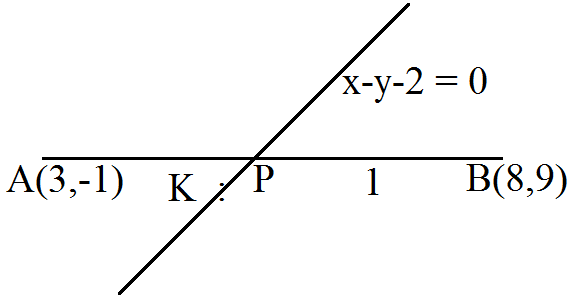
$\therefore$ Coordinates of P are $\Big(\frac{\text{k}\times8+1\times3}{\text{k}+1},\frac{\text{k}\times9+1\times(-1)}{\text{k}+1}\Big)$ Or $\Big(\frac{8\text{k}+3}{\text{k}+1},\frac{9\text{k}-1}{\text{k}+1}\Big)$ p lies on the line x - y - 2 = 0 $\therefore\frac{8\text{k}+3}{\text{k}+1},\frac{9\text{k}-1}{\text{k}+1}-2=0$ Multiplying by k + 1. $(8\text{k}+3)-(9\text{k}-1)-2(\text{k}+1)=0$ $\Rightarrow\ 8\text{k}-9\text{k}+3+1-2\text{k}-2=0$ $\Rightarrow-3\text{k}+2=0\ \therefore\text{k}=\frac{2}{3}$ Thus the line x - y - 2 = 0 divides AB in the ratio 2 : 3.
View full question & answer
Question 25 Marks
For what value of $x$ are the points $A(-3, 12), B(7, 6)$ and $C(x, 9)$ colinear?
Answer
Let $A(-3, 12) = B(7, 6)$ and $C(x, 9)$ are the given points.
then, $(x_1 = -3, y_1 = 12), (x_2 = 7, y_2 = 6)$ and $(x_3 = x, y_3 = 9)$
It is given that the points A, B and C are collinear. therefore,
$x_1(y_2 - y_3) + x_2(y_3 - y_1) + x_3(y_1 - y_2) = 0$
$ \Rightarrow (-3)(6 - 9) + 7(-3) + x(6) = 0 $
$\Rightarrow 9 - 21 + 6x = 0$
$ \Rightarrow 6x - 12 = 0 $
$\Rightarrow 6x = 12$
$\Rightarrow\text{x}=\frac{12}{6}=2$
Therefore, when $x = 2$, the given points are collinear.
View full question & answer
Question 35 Marks
If the points $P(-3, 9), Q(a, b)$ and $R(4, -5)$ are collinear and $a + b = 1$, find the values of $a$ and $b$.
Answer
Let $A(x_1 = -3, y_1 = 9), B(x_2 = a, y_2 = b$) and $(x_3 = 4, y_3 = -5)$ be the given points.
The given that the point are collinear if,
$x_1(y_2 - y_3) + x_2(y_3 - y_1) + x_3(y_1 - y_2) = 0$
$\Rightarrow (-3)(b + 5) + a(-5 - 9) + 4(9 - b) = 0$
$\Rightarrow -3b - 15 -14a + 36 - 4b = 0$
$\Rightarrow 2a + b = 3$
Now, solving $a + b = 1$ and $2a + b = 3$, We get $a = 2$ and $b = -1$.
Hence, $a = 2$ and $b = -1$.
View full question & answer
Question 45 Marks
Prove that the points $A(a, 0), B(0, b)$ and $C(1, 1)$ are collinear, if $\frac{1}{\text{a}{}}+\frac{1}{\text{b}}=1.$
Answer
Consider the point $A(a, 0), B(0, b), $ and $C(1, 1)$
Here, $(x_1 = x, y_1 = y), B (x_2 = -5, y_2 = 7)$ and $(x_3 = -4, y_3 = 5)$ be the given points.
it is given that the point are collinear so,
$x_1(y_2 - y_3) + x_2(y_3 - y_1) + x_3(y_1 - y_2) = 0$
$\Rightarrow a(b - 1) + 0(1 - 0) + 1(0 - b) = 0$
$\Rightarrow ab - a - b = 0$
Dividing the equation by ab:
$\Rightarrow1-\frac{1}{\text{b}}-\frac{1}{\text{a}}=0$
$\Rightarrow1-\Big(\frac{1}{\text{a}}+\frac{1}{\text{b}}\Big)=0$
$\Rightarrow\Big(\frac{1}{\text{a}}+\frac{1}{\text{b}}\Big)=1$
Therefore, the given point are collinear if $\Big(\frac{1}{\text{a}}+\frac{1}{\text{b}}\Big)=1.$
View full question & answer
Question 55 Marks
Using the distance formula, show taht the given points are collinear:
(-1, -1), (2, 3) and (8, 11)
Answer
Let A(-1, -1), B(2, 3) and C(8, 11) be the given points
Then,
$\text{AB}=\sqrt{(2-1)^2+(3+1)^2}=\sqrt{(3)^2+(4)^2}$
$=\sqrt{9+16}=\sqrt{25}=5\text{ units}$
$\text{BC}=\sqrt{(8-2)^2+(11-3)^2}=\sqrt{(6)^2+(8)^2}$
$=\sqrt{36+64}=\sqrt{100}=10\text{ units}$
$\text{AC}=\sqrt{(8+1)^2+(11+1)^2}=\sqrt{(9)^2+(12)^2}$
$=\sqrt{81+144}=\sqrt{225}=15\text{ units}$
$\therefore\text{AB}+\text{AC}=5+10=15\text{ units}=\text{BC}$
$\Rightarrow\text{AB}+\text{AC}=\text{BC}$
Hence, the given points are collinear.
View full question & answer
Question 65 Marks
If the point $P(2, 2)$ is equidistant from the points $A(-2, k)$ and $B(-2k , -3)$,
find k. Also, find the length of AP.
Answer
It is being given that $P(2, 2)$ is equidustant from the points $A(-2, k)$ and $B(-2k, -3)$.
Thus, we have
$AP = BP$
$\Rightarrow AP^2 = BP^2$
$\Rightarrow (-2 - 2)^2 + (k - 2)^2 = (-2k - 2)^2 + (-3 - 2)^2$
$\Rightarrow (-4)^2 + (k^2 + 4 - 4k) = (4k^2 + 4 + 8k) + (-5)^2$
$\Rightarrow 16 + k^2 + 4 - 4k = 4k^2 + 4 + 8k + 25$
$\Rightarrow k^2 - 4k + 20 = 4k^2 + 8k + 29$
$\Rightarrow 3k^2 + 12k + 9 = 0$
$\Rightarrow 3k^2 + 3k + 9k + 9 = 0$
$\Rightarrow 3k(k + 1) + 9(k + 1) = 0$
$\Rightarrow (k + 1)(3k + 9) = 0$
$\Rightarrow k + 1 = 0$ or $3k + 9 = 0$
$\Rightarrow k = -1$ or $k = -3$
When, k = -1
$\text{AP}=\sqrt{(-2-2)^2+(-1-2)^2}$
$=\sqrt{(-4)^2+(-3)^2}$
$=\sqrt{16+9}$
$=\sqrt{25}=5$
$\Rightarrow\text{AP}=5\text{ units}$
When, $k = -3$
$\text{AP}=\sqrt{(-2-2)^2+(-3-2)^2}$
$=\sqrt{(-4)^2+(-5)^2}$
$=\sqrt{16+25}$
$=\sqrt{41}$
$\Rightarrow\text{AP}=\sqrt{41}\text{units}$
View full question & answer
Question 75 Marks
$A(6, 1), B(8, 2)$ and $C(9, 4)$ are the vertices of a parallelogram ABCD. If E is the midpoint of DC, find the area of $\triangle\text{ADE}.$
Answer
Let $(x, y)$ be the coordinats of D and $(x', y')$ be the coordinates of E.
since, the diagonals of a parallelogram bisect each other of the same point, therefore $\frac{\text{x}+8}{2}=\frac{6+9}{2}=\text{x}=7$
$\frac{\text{y}+2}{2}=\frac{1+4}{2}=\text{y}=3$
Thus, the coordinates of D are (7, 3). E is the midpoint of DC, therefore
$\text{x}'=\frac{7+9}{2}=\text{x}'=8$
$\text{y}'=\frac{3+4}{2}=\text{y}'=\frac{7}{2}$
Thus, the coordinats of E are $\Big(8,\frac{7}{2}\Big).$
Let $A(x_1, y_1) = A(6, 1), E(x_2, y_2) = E$$\Big(8,\frac{7}{2}\Big).$ and $D(x_3, x_4) = D(7, 3).$
Now,
$\text{ar}(\triangle\text{ABC})=\frac{1}{2}[\text{x}_1(\text{y}_2-\text{y}_3)+\text{x}_2(\text{y}_3-\text{y}_1)+\text{x}_3(\text{y}_1-\text{y}_2)]$ $=\frac{1}{2}\Big[6\Big(\frac{7}{2}-3\Big)+8(3-1)+7\Big(1-\frac{7}{2}\Big)\Big]$ $=\frac{1}{2}\big[\frac{3}{2}\big]$ $=\frac{3}{4}\text{sq. units}$ Hence, the area of the triangle $\triangle\text{ADE}$ is $\frac{3}{4}$sq. units.
View full question & answer
Question 85 Marks
Find the distance between of the following points from the origin:
C(-4, -6)
Answer
The gven point is A(-4, -6) and let O(0, 0) be the origin
Then, $\text{CO}=\sqrt{(-4-0)^2+(-6-0)^2}$
$=\sqrt{(-4)^2+(-6)^2}$
$=\sqrt{16+36}$
$=\sqrt{52}=2\sqrt{13}\text{ units}.$
View full question & answer
Question 95 Marks
For what values of k are points $A(8, 1), B(3, -2k)$ and $C(k, -5)$ collinear.
Answer
Let $A(x_1 = 8, y_1 = 1), B(x_2 = 3, y_2 = -2k)$ and $(x_3 = k, y_3 = -5)$ be the given points.
The given point are collinear if
$x_1(y_2 - y_3) + x_2(y_3 - y_1) + x_3(y_1 - y_2) = 0 $
$\Rightarrow 8(-2k + 5) + 3(-5 - 1) + k(1 + 2k) = 0$
$ \Rightarrow -16k + 40 - 18 + k + 2k^2 = 0$
$ \Rightarrow 2k^2 - 11k - 4k + 22 = 0 $
$\Rightarrow k(2k - 11) -2(2k - 11) = 0 $
$\Rightarrow (k - 2)(2k - 11) = 0$
$ \Rightarrow k = 2$ or $\text{k}=\frac{11}{2}$
Hence, $k = 2$ or $\text{k}=\frac{11}{2}$
View full question & answer
Question 105 Marks
If $\text{a}\not=\text{b}\not=\text{c},$ prove that $(a, a^2), (b. b^2), (0, 0)$ will not be collinear.
Answer
Missing
View full question & answer
Question 115 Marks
Find points on the x-axis, each of which is at a distance of $10$ units from the point $A(11, -8)$.
Answer
Let $A(11, -8)$ be the given point and let $P(x, 0)$ be the required point on x-axis
Then,
$PA = 10$ units $\Rightarrow PA^2 = 100$
$\Rightarrow (x - 11)^2 + (0 + 8)^2 = 100$
$\Rightarrow x^2 + 121 - 22x + 64 = 100$
$\Rightarrow x^2- 22x + 185 - 100 = 0$
$\Rightarrow x^2 - 22x + 85 = 0$
$\Rightarrow x^2 - 17x - 5x + 85 = 0$
$\Rightarrow x(x - 17) - 5(x - 17) = 0$
$\Rightarrow (x - 17)(x - 5) = 0$
$\Rightarrow x = 17$ or $x = 5$
Hence, the required points are $(17, 0)$ and $(5, 0).$
View full question & answer