Question
Using the standard electrode potentials given in the Table, predict if the reaction between the following is feasible:
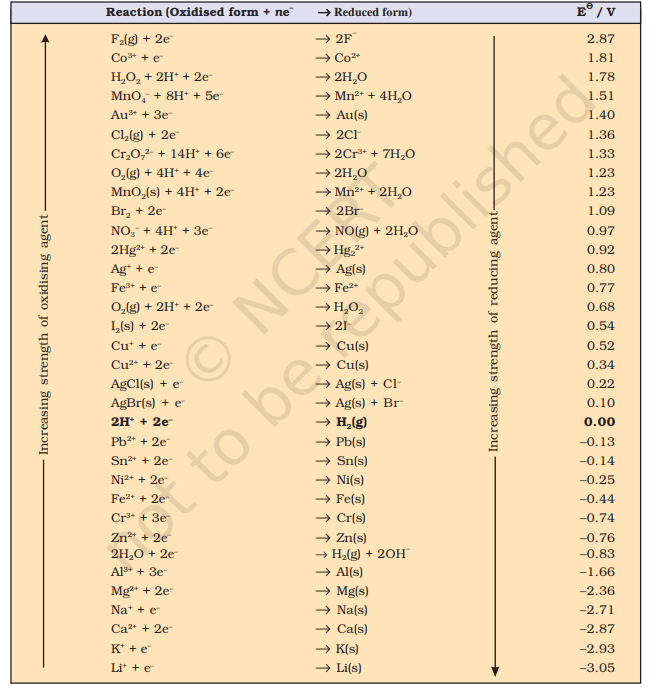
$\mathrm{Fe}^{3+}(\mathrm{aq})$ and $\mathrm{Cu}(\mathrm{s})$.

Answer

The possible reaction between $\mathrm{Fe}^{3+}(\mathrm{aq})$ and $\mathrm{Cu}(\mathrm{s})$. is given by, $2\text{Fe}^{3+}_{(\text{aq})}+\text{Cu}_{(\text{s})}\rightarrow2\text{Fe}^{2+}_{(\text{s})}+\text{Cu}^{2+}_{(\text{aq})}$ $\text{Oxidation half equation:}\ \ \ \ \ \ \ \text{Cu}_{(\text{s})}\xrightarrow{\ \ \ \ \ \ }\text{Cu}^{2+}_{(\text{aq})}+2\text{e}^-;\ \ \text{E}^\circ=-0.34\text{V}\\\text{Reduction half equation:}\ \ [\text{Fe}^{3+}_{(\text{aq})}+\text{e}^-\xrightarrow{\ \ \ \ \ }\text{Fe}^{2+}_{(\text{s})}]\times2;\ \ \ \text{E}^\circ=+0.77\text{V}\\\overline{\ \ \ \ \ \ \ \ \ \ \ \ \ \ \ \ \ \ \ \ \ \ \ \ \ \ \ \ \ \ \ \ \ \ \ \ \ \ \ \ \ \ \ \ \ \ \ \ \ \ \ \ \ \ \ \ \ \ \ \ \ \ \ \ \ \ \ \ \ \ \ \ \ \ \ \ \ \ \ \ \ \ \ \ \ \ \ \ \ \ \ \ \ \ \ \ \ \ \ \ \ \ \ \ \ \ \ \ \ \ \ \ \ \ \ \ \ \ }\\\ \ \ \ \ \ \ \ \ \ \ \ \ \ \ \ \ \ \ \ \ \ \ \ \ \ \ \ \ \ \ \ 2\text{Fe}^{3+}_{(\text{aq})}+\text{Cu}_{(\text{s})}\xrightarrow{\ \ \ \ \ }2\text{Fe}^{2+}_{(\text{s})}+\text{Cu}^{2+}_{(\text{aq})};\ \ \ \text{E}^\circ=+0.43\text{V}$E° positive for the overall reaction is positive. Hence, the reaction between $\mathrm{Fe}^{3+}(\mathrm{aq})$ and $\mathrm{Cu}(\mathrm{s})$. is feasible.

Need a full question paper?

Generate a complete, print-ready paper with questions like this in minutes — across 16+ boards, with answer keys.

Start Generating Free

Similar questions

a. Name two compounds of sodium used in textile industry.
b. Why is sulphur estimated as $\mathrm{BaSO}_4$ and not as $\mathrm{MgSO}_4$ ?
c. $\mathrm{BeCl}_2$ is covalent where as $\mathrm{CaCl}_2$ is ionic, why?
Lithium resembles magnesium in some of its properties. Mention two such properties and give reasons for this resemblance.
The arrangement of orbitals on the basis of energy is based upon their (n + l) value. Lower the value of (n + l), lower is the energy. For orbitals having same values of (n + l), the orbital with lower value of n will have lower energy.
  1. Based upon the above information, arrange the following orbitals in the increasing order of energy.
  1. 1s, 2s, 3s, 2p
  2. 4s, 3s, 3p, 4d
  3. 5p, 4d, 5d, 4f, 6s
  4. 5f, 6d, 7s, 7p
  1. Based upon the above information, solve the questions given below:
  1. Which of the following orbitals has the lowest energy?
4d, 4f, 5s, 5p
  1. Which of the following orbitals has the highest energy?
5p, 5d, 5f, 6s, 6p
  1. Calculate the mole fraction of water in a mixture of $15g$ water, $18g$ acetic acid and $84g$ ethyl alcohol.
  2. Excess the following numbers to four significant figures.
  • $3.607892$
  • $6.5869 \times 10^3$
  1. Write balanced chemical equation for the following:
$KMnO_4 + C_2H_4 + H_2O → MnO_2 +KOH+ (CH_2OH)_2$
Write the electronic configurations of the following ions :
  1. $H^–$
  2. $Na^+$
  3. $O^{2–}$
  4. $F^–$
1 M solution of $\mathrm{NaNO}_3$ has density $1.25 \mathrm{~g} \mathrm{~cm}^{-3}$. Calculate its molality.
(Mol. weight of $\mathrm{NaNO}_3=85 \mathrm{~g} \mathrm{~mol}^{-1}$ )
A nonmetallic element of group 13, used in making bullet proof vests is extremely hard solid of black colour. It can exist in many allotropic forms and has unusually high melting point. Its trifluoride acts as Lewis acid towards ammonia. The element exihibits maximum covalency of four. Identify the element and write the reaction of its trifluoride with ammonia. Explain why does the trifluoride act as a Lewis acid.
Complete the following reactions:
  1. $\text{Zn}+\text{NaOH}\xrightarrow{\ \ \ \ \ \ \ }$
  2. $\text{MnO}_4^-+\text{H}_2\text{O}_2\xrightarrow{\ \ \ \ \ \ \ \ \ }$
  3. $\text{Ca(HCO}_3)_2+\text{Ca(OH)}_2\xrightarrow{\ \ \ \ \ \ \ \ \ \ }$
1 mole of an ideal gas undergoes reversible isothermal expansion from an initial volume of $V _1$ to a final volume of $10 V_1$ and does 10 kJ of work. The initial pressure was $1 \times 10^7 Pa$.
1. Calculate $V _1$.
2. If there were 2 moles of gas what must its temperature have been?
10 mL of H , combine with 5 mL of $\mathrm{O}_2$ to form water. When 200 mL of H , at STP is passed over heated CuO, the CuO loses 0.144 g of its weight. Does the above data correspond to the law of constant composition?