Question
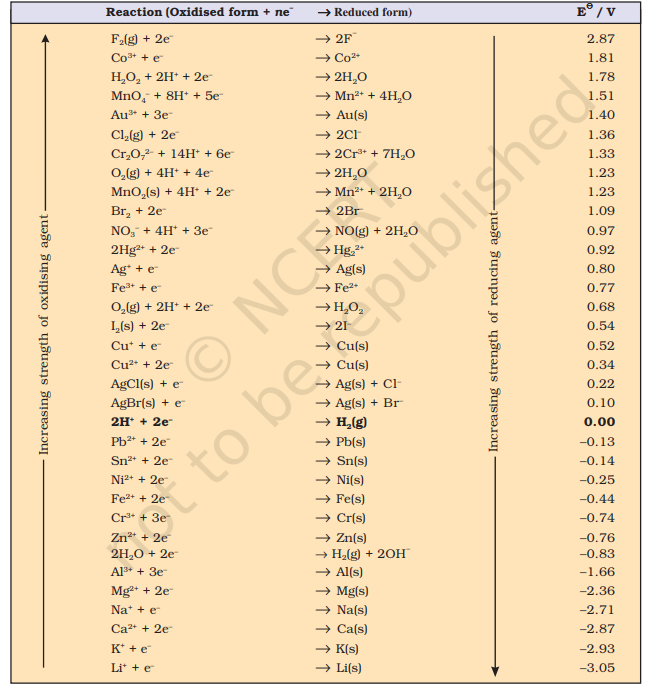
Using the standard electrode potentials given in the Table, predict if the reaction between the following is feasible:
Fe3+(aq) and I-(aq).

Answer

The possible reaction between Fe3+(aq) + I-(aq) is given by,

$2\text{Fe}^{3+}_{(\text{aq})}+2\text{I}^-_{(\text{aq})}\rightarrow2\text{Fe}^{2+}_{(\text{aq})}+\text{I}_{2(\text{s})}$

$\text{Oxidation half equation:}\ \ \ \ \ \ \ \ \ \ 2\text{I}^-_{(\text{aq})}\xrightarrow{\ \ \ \ \ \ \ }\text{I}_{2(\text{s})}+2\text{e}^-;\ \ \text{E}^\circ=-0.54\text{V}\\\text{Reduction half equation:}\ [\text{Fe}^{3+}_{(\text{aq})}+\text{e}^-\xrightarrow{\ \ \ \ \ \ }\text{Fe}^{2+}_{(\text{aq})}]\times2;\ \ \text{E}^\circ=+0.77\text{V}\\\overline{\ \ \ \ \ \ \ \ \ \ \ \ \ \ \ \ \ \ \ \ \ \ \ \ \ \ \ \ \ \ \ \ \ \ \ \ \ \ \ \ \ \ \ \ \ \ \ \ \ \ \ \ \ \ \ \ \ \ \ \ \ \ \ \ \ \ \ \ \ \ \ \ \ \ \ \ \ \ \ \ \ \ \ \ \ \ \ \ \ \ \ \ \ \ \ \ \ \ \ \ \ \ \ \ \ \ \ \ \ \ \ \ \ \ \ \ \ \ }\\ \ \ \ \ \ \ \ \ \ \ \ \ \ \ \ \ \ \ \ \ \ \ \ \ \ \ \ \ \ \ \ \ \ \ \ \ \ \ 2\text{Fe}^{3+}_{(\text{aq})}+2\text{I}^-_{(\text{aq})}\xrightarrow{\ \ \ \ \ \ \ \ }2\text{Fe}^{2+}_{(\text{aq})}+\text{I}_{2(\text{s})};\ \ \text{E}^\circ=+0.23\text{V}$

E° for the overall reaction is positive. Thus, the reaction between $\text{Fe}^{3+}_{(\text{aq})}$ and $\text{I}^-_{(\text{aq})}$ is feasible.

Need a full question paper?

Generate a complete, print-ready paper with questions like this in minutes — across 16+ boards, with answer keys.

Start Generating Free

Similar questions

10g of argon is compressed isothermally and reversibly at a temperature of 27°C from 10L to 5L. Calculate q, W, $\Delta\text{U}$ and $\Delta\text{H}$ for this process. R = 2.0cal K-1 mol-1, log2 = 0.30, atomic weight, of Ar = 40.
Equal volumes of 0.002 M solutions of sodium iodate and cupric chlorate are mixed together. Will it lead to precipitation of copper iodate? (For cupric iodate $K_{s p}=7.4 \times 10^{-8}$ )
Predict the dipole moment of
1. a molecule of the type $AX _2$ having a linear geometry.
2. a molecule of the type $AX _4$ having tetrahedral geometry.
3. a molecule of the type $AX _2$ having angular geometry.
4. a molecule of the type $AX _4$ having square planar geometry.
How does Cu2O act as both oxidant and reductant? Explain with proper reactions showing the change of oxidation numbers in each example.
Justify the following statements.
  1. Reactions with $\Delta\text{G}<0$ always have an equilibrium constant greater than 1.
  2. Many thermodynamically feasible reactions do not occur under ordinary conditions.
  3. At low temperatures, enthalpy change dominates the $\Delta\text{G}$ expression and at high temperatures, it is the entropy which dominates the value of $\Delta\text{G}.$
Which of the following pairs of elements would have a more negative electron gain enthalpy?
F or Cl
  1. State first law of thermodynamics.
  2. Heat (q) and work function (w) individually are not state functions but their sum is always a state function. Why?
  3. Define extensive property with example.
For an actual result of an observation to be 5; two students A and B reported their readings as follows:
 
Observation number
Average
1
2
Student A
4.95
4.93
4.94
Student B
4.94
5.05
4.995
Which of the students has made a more precise observation? Is his observation accurate too?
Calculate the volume of 02 at STP liberated by heating 12.25g of KClO3
(At. wt. of K = 39, Cl = 35.5, 0 = 16u)
PbO and $PbO _2$ react with HCl according to the following chemical equations:
$
\begin{aligned}
& 2 PbO+4 HCl \rightarrow 2 PbCl_2+2 H_2 O \\
& PbO_2+4 HCl \rightarrow PbCl_2+Cl_2+2 H_2 O
\end{aligned}
$
Why do these compounds differ in their reactivity?