Question
Solid Ba(NO3), is gradually dissolved in a 1.0 × 10⁻⁴ M Na2CO3 solution. At what concentration of Ba2+ will a precipitate begin to form.(Ksp for BaCO3 = 5.1 × 10⁻⁹)

Answer

$\text{BaCO}_3(\text{s})\rightleftharpoons\text{Ba}^{2+}+\text{CO}^{2-}_{3}$
$\text{Na}_2\text{CO}_3\xrightarrow{\ \ \ \ \ \ \ \ }2\text{Na}^++\text{CO}^{2-}_3$
$[\text{Na}_2\text{CO}_3]=1.0\times10^{-4}\text{M}$
$\text{K}_{\text{sp}}=[\text{Ba}^{2+}][\text{CO}_3^{2-}]$
$5.1\times10^{-9}=[\text{Ba}^{2+}][1\times10^{-4}\text{M}]$
$\text{[Ba}^{2+}]=\frac{5.1\times10^{-9}}{1\times10^{-4}}$
$=5.1\times10^{-5}\text{M}$
At 5.1 × 10-5M concentration of [Ba2+], I.P(ionic product) will become equal to Ksp and precipitate will begin to from.

Need a full question paper?

Generate a complete, print-ready paper with questions like this in minutes — across 16+ boards, with answer keys.
Start Generating Free

Similar questions

  1. Determine group and block of elements with atomic number 29 and 35.
  2. Define $\pi$ bonds.
Draw the molecular structures of:
  1. $\text{XeF}_2,$
  2. $\text{XeOF}_2$
  3. $\text{XeOF}_4$
Give two similarities and one difference between Boron and Aluminium.
0.5 mole each of H2S and SO2 mixed together in a reaction Flask, react according to equation:
2H2S + SO2 → 2H2 + 3S
Calculate the number of moles of 'S' formed.
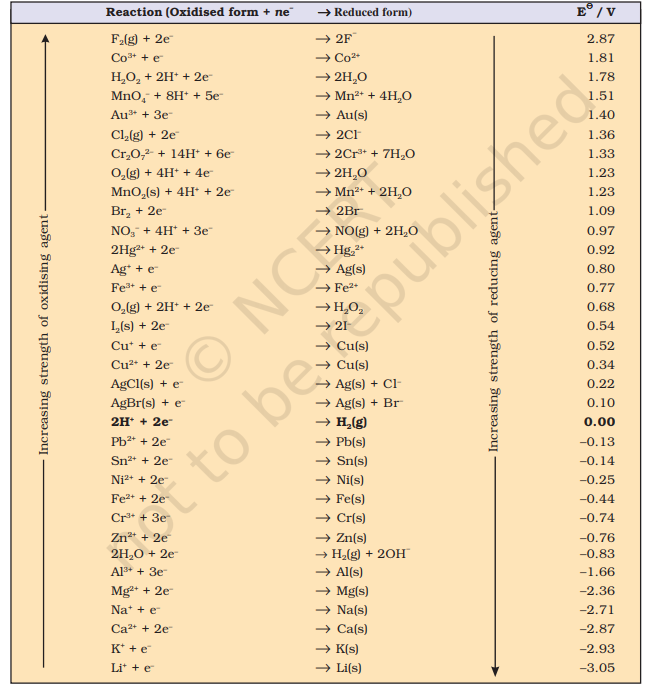
Using the standard electrode potentials given in the Table, predict if the reaction between the following is feasible:

Br2(aq) and Fe2+(aq).
1. The fact that the enthalpy is a state function forms the basis of a very useful law. Name the law.
2. If the combustion of 1 g of graphite produces 20.7 kJ of heat, what will be molar enthalpy change? Give the significance of the sign also.
3. Consider the same expansion, but this time against a constant external pressure of 1 atm.
Which of the following reactions will get affected by increasing the pressure? Also, mention whether change will cause the reaction to go into forward or backward direction.
(i) $COCl _2(g) \rightleftharpoons CO ( g )+ Cl _2(g)$
(ii) $CH _4(g)+2 S_2(g) \rightleftharpoons CS _2(g)+2 H _2 S( g )$
(iii) $CO _2(g)+ C ( s ) \rightleftharpoons 2 CO ( g )$
(iv) $2 H _2(g)+ CO ( g ) \rightleftharpoons CH _3 OH ( g )$
(v) $CaCO _3(s) \rightleftharpoons CaO ( s )+ CO _2(g)$
(vi) $4 NH _3(g)+5 O _2(g) \rightleftharpoons 4 NO ( g )+6 H _2 O ( g )$
The density of 3 M solution of NaCl is $1.25 g mL ^{-1}$. Calculate the molality of the solution.
Write structures of all the alkenes which on hydrogenation give 2-methylbutane.
The solubility of $Sr ( OH )_2$ at 298 K is $19.23 g / L$ of solution. Calculate the concentration of strontium and hydroxyl ions and the pH of the solution.