Question
Using Valence bond theory, explain the following in relation to the paramagnetic complex $[Mn(CN)_6]^{3-}$
$a.$ type of hybridisation
$b.$ magnetic moment value
$c.$ type of complex $-$ inner, outer orbital complex
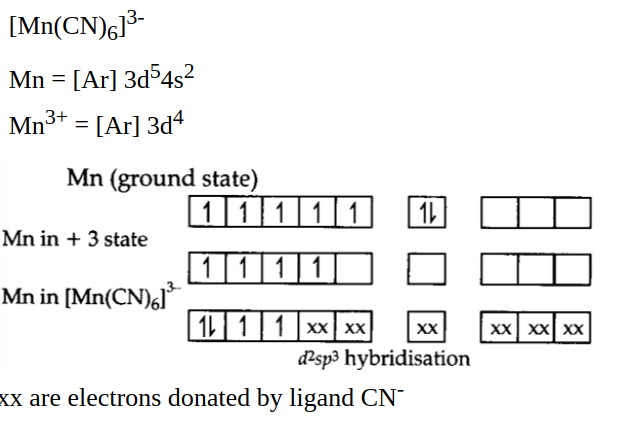
Answer


Image
$a.$ Type of hybridisation $- d^{2}sp^{3}$
$b.$ Magnetic moment value
$=\sqrt{n(n+2)}=\sqrt{2(2+2)}=2.87 \ BM$
$(n =$ no. of unpaired electrons$)$
$c.$ Type of complex $- $ inner orbital

Need a full question paper?

Generate a complete, print-ready paper with questions like this in minutes — across 16+ boards, with answer keys.

Start Generating Free

Similar questions

Write the $" \text{IUPAC}"$ names of the following coordination compounds:
$a. \left[ Pt \left( NH _3\right)_2 Cl \left( NO _2\right]\right.$
$b. K _3\left[ Cr \left( C _2 O _4\right)_3\right]$
$c. \left[ CoCl _2( en )_2\right] Cl$
$d. \left[ Co \left( NH _3\right)_5\left( CO _3\right)\right] Cl$
$e. Hg \left[ Co ( SCN )_4\right]$
Describe the structure of a fuel cell. Draw labelled diagram of a structure of fuel cell?
Mention the IUPAC rule used to write the formulas of mononuclear coordination compounds.
For an elementary reaction:
$2 A+B \rightarrow 3 C$
the rate of appearance of $C$ at time ' t ' is $1.3 \times 10-4 mol L ^{-1} s^{-1}$. Calculate at this time:
a. Rate of the reaction.
b. Rate of disappearance of $A.$
Match the items of Column I with items of Column II and assign the correct code:
 
Column I
 
Column II
(A)
Coloured bands
(1)
Zone refining
(B)
LImpure matal to volatie complex
(2)
Fractional distillation
(C)
Purification of Ge and Si
(3)
Mond process
(D)
Purification of mercury
(4)
Chromatophy
 
 
(5)
Liquation
  1. A (1) B (2) C (4) D (5)
  2. A (4) B (3) C (1) D (2)
  3. A (3) B (4) C (2) D (1)
  4. A (5) B (4) C (3) D (2)
Match the types of colloidal systems given in Column I with the name given in Column II.
  Column I   Column II
(i) Solid in liquid. (a) Foam.
(ii) Liquid in solid. (b) Sol.
(iii) Liquid in liquid. (c) Gel.
(iv) Gas in liquid. (d) Emulsion.
  1. Assign reasons for the following:
i. $PbO _2$ is a stronger oxidising agent than $SnO _2$.
ii. In solid state $PCl _5$ behaves as an ionic species.
iii. Aluminium chloride $\left( AlCl _3\right)$ is very often used as a catalyst.
  1. What is the structural difference between orthosilicates and pyrosilicates?
$(a).$ While giving intravenous injections to the patients, the doctors take utmost care of the concentration of the solution used. Why is it necessary to check the concentration of the solution?
$(b).$ A solution of phenol was obtained by dissolving $2 \times10^{-2} \ kg$ of phenol in $1 \ kg$ of benzene. Experimentally it was found to be $73\%$ associated. Calculate the depression in the freezing point recorded.
Explain the mechanism and reactivity of nucleophilic addition reactions of carbonyl compounds (Aldehyde and ketone).
Attempt any five of the following$:$
$(a)$ Deficiency of which vitamin causes night$-$blindness.
$(b)$ Give two examples of reducing sugars.
$(c$) Define the following terms$:$
$i.$ Glycosidic linkage
$ii.$ Native protein
$(d)$ Write function of carbohydrates in plants.
$(e)$ Differentiate between$:$
$i.$ Peptide linkage and Glycosidic linkage
$ii.$ Nucleoside and Nucleotide
$(f)$ What type of linkage holds together the monomers of $ \text{DNA}?$
$(g$) Write the product obtained when $D-$glucose reacts with $H_2N-OH.$