The rope shown at an instant is carrying a wave travelling towards right, created by a source vibrating at a frequency $n$. Consider the following statements
$I.$ The speed of the wave is $4n \times ab$
$II.$ The medium at $a$ will be in the same phase as $d$ after $\frac{4}{{3n}}s$
$III.$ The phase difference between $b$ and $e$ is $\frac{{3\pi }}{2}$
Which of these statements are correct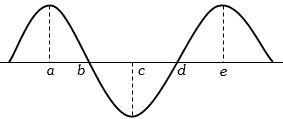
Medium


Download our appand get started for free
Experience the future of education. Simply download our apps or reach out to us for more information. Let's shape the future of learning together!No signup needed.*
Similar Questions
- 1View SolutionAn observer is moving towards the stationary source of sound, then
- 2One insulated conductor from a household extension cord has a mass per unit length of $μ.$ A section of this conductor is held under tension between two clamps. A subsection is located in a magnetic field of magnitude $B$ directed perpendicular to the length of the cord. When the cord carries an $AC$ current of $"i"$ at a frequency of $f,$ it vibrates in resonance in its simplest standing-wave vibration state. Determine the relationship that must be satisfied between the separation $d$ of the clamps and the tension $T$ in the cord.View Solution
- 3If the threshold of hearing is assumed to be the reference $(0\ dB)$ , then the threshold of pain is taken to be $120\ dB$ . Let the corresponding sound intensities be $I_0$ and $I$ respectively. Then $\frac{{{I_0}}}{I}$ isView Solution
- 4A transverse wave is represented by $y=2 \sin$ $(\omega t - kx ) cm$. The value of wavelength (in $cm$ ) for which the wave velocity becomes equal to the maximum particle velocity, will be.View Solution
- 5Unlike a laboratory sonometer, a stringed instrument is seldom plucked in the middle. Supposing a sitar string is plucked at about $\frac{1}{4}$th of its length from the end. The most prominent harmonic would beView Solution
- 6$Assertion :$ A transverse waves are produced in a very long string fixed at one end. Only progressive wave is observed near the free end.View Solution
$Reason :$ Energy of reflected wave does not reach the free end. - 7A string of length $1\,\,m$ and linear mass density $0.01\,\,kgm^{-1}$ is stretched to a tension of $100\,\,N.$ When both ends of the string are fixed, the three lowest frequencies for standing wave are $f_1, f_2$ and $f_3$. When only one end of the string is fixed, the three lowest frequencies for standing wave are $n_1, n_2$ and $n_3$. ThenView Solution
- 8Consider two sound sources $S_1$ and $s_2$ having same frequency $100\,\,Hz$ and the observer $O$ located between them as shown in the fig. All the three are moving with same velocity in same direction. The beat frequency of the observer is .... $Hz$View Solution

- 9The equation of a wave is $y = 2\sin \pi (0.5x - 200t)$, where $x$ and $y$ are expressed in $cm$ and $t$ in $sec.$ The wave velocity is ...... $cm/sec$View Solution
- 10The wave equation is $y = 0.30\sin (314t - 1.57x)$ where $t, x$ and $y$ are in second, meter and centimeter respectively. The speed of the wave is ..... $m/s$View Solution