MCQ
Variable valency is shown by
  • A
    Typical elements
  • B
    Normal elements
  • Transition elements
  • D
    None of these

Answer

Correct option: C.
Transition elements
c
(c)Transition metals show variable valency.

Need a full question paper?

Generate a complete, print-ready paper with questions like this in minutes — across 16+ boards, with answer keys.
Start Generating Free

Similar questions

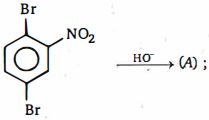
Product of the given reaction is
The standard reduction potentials for $Zn^{2+}/zn,$ $Ni^{2+} /Ni$ and $Fe^{2+}/Fe$ are $-0.76,-0.23$ and $-0.44\, V$ respectively.

The reaction $X+Y^{2+} \rightarrow x^{2+} +Y$ will be spontaneous when :
The correct statement regarding nucleophilic substitution reaction in a chiral alkyl halide is ;
Which one will liberate $B{r_2}$ from $KBr$
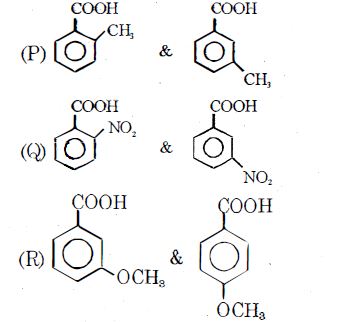
The set representing more acidic among each of the following $3$ pairs is
$CH_3 CH_2CH(OH)CH(CH_3)_2 + CH_3COCl \xrightarrow{base} $ $CH_3CH_2CH(OCOCH_3 )CH(CH_3)_2 + HCl$

In the above reaction, if the reactant alcohol is a pure $R-$ isomer the product would.

The standard Gibbs energy for the given cell reaction in $kJ\,mol^{-1}$ at $298\,K$ is $Zn(s)\, + \,C{u^{2 + }}(aq)\, \to \,Z{n^{2 + }}(aq) + Cu\,(s)\,,\,{E^o} = 2\,V$ at $298\,K$ [Faraday’s constant $F = 96500\,C\,mol^{-1}$ ]
Consider the following statements :
$(1)$ Bridgehead halides are inert towards both $S_{N^1}$ and $S_{N^2}$ reactions ( till one of the ring size is eight member ring) 
$(2)$ The first step in both $S_{N^1}$ and $E_1$ reactions is the same 
$(3)$ $S_{N^2}$ reactions proceed with total retention of configuration
$(4)\, E_2$ eliminations are by the use of a solvent of low polarity and high  concentration of a strong base 

Which of the above statements are correct?

The process of separating of cream from milk is called:
The oxidation state of $Mo$ in its oxo-complex species $[Mo_2O_4(H_2O)_2(C_2H_4)_2]^{2-}$ is :