MCQ
Variation in electric potential is maximum if one goes
  • along the line of force
  • B
    perpendicular to the line of force
  • C
    in any direction
  • D
    no variation in any direction

Answer

Correct option: A.
along the line of force
a
$\Delta \mathrm{V}=-\int \overrightarrow{\mathrm{E}} \cdot \mathrm{d} \overrightarrow{\mathrm{r}} \quad \therefore \Delta \mathrm{V} \propto \cos \theta$

$\Delta \mathrm{V}$ is max. for $\theta=0^{\circ}$ or $\theta=180^{\circ}$

Need a full question paper?

Generate a complete, print-ready paper with questions like this in minutes — across 16+ boards, with answer keys.
Start Generating Free

Similar questions

Photons of energy $6 eV$ are incident on a metal surface whose work function is $4 eV$. The minimum kinetic energy of the emitted photo-electrons will be ........... $eV$
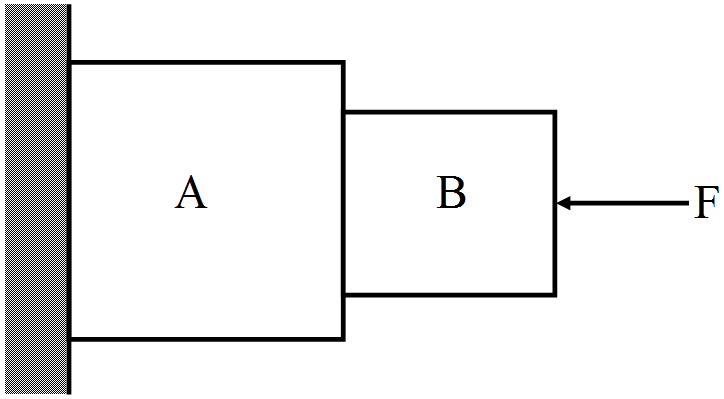
Consider the situation shown in figure. The wall smooth but the surface of A and B in contact are rough. The friction on B due to A in equilibrium:
Assertion : Magnetism is relativistic.
Reason : When we move along with the charge so that there is no motion relative to us, we find no magnetic field associated with the charge.
In the propagation of electromagnetic waves the angle between the direction of propagation and plane of polarisation is
When the modulating frequency is doubled, the modulation index is halved and the modulating voltage remains constant, the modulation system is
In a Young's double slit experiment, the fringe width will remain same, if ($D =$ distance between screen and plane of slits, $d =$ separation between two slits and $\lambda =$ wavelength of light used)
An unpolarized light passes through three polarizing sheets whose polariging directions make an angle of $30^o$ , $60^o$ and $30^o$ with $y$ axis in same sense. What fraction of initial intensity is transmitted by the system ?
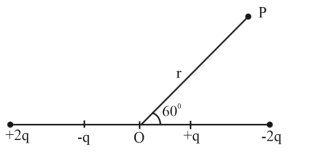
The distance between charges $+\mathrm{q}$ and $-\mathrm{q}$ is $2 l$ and between $+2 \mathrm{q}$ and $-2 \mathrm{q}$ is $4 l$. The electrostatic potential at point $P$ at a distance $r$ from centre $O$ is $-\alpha\left[\frac{q l}{r^2}\right] \times 10^9 \mathrm{~V}$, where the value of $\alpha$ is____. (Use $\left.\frac{1}{4 \pi \varepsilon_0}=9 \times 10^9 \mathrm{Nm}^2 \mathrm{C}^{-2}\right)$
In an experiment of meter bridge, a null point is obtained at the centre of the bridge wire. When a resistance of 10 ohm is connected in one gap, the value of resistance in other gap is
The energy gap in a conductor at room temperature is $.........$ .