MCQ
In a Young's double slit experiment, the fringe width will remain same, if ($D =$ distance between screen and plane of slits, $d =$ separation between two slits and $\lambda =$ wavelength of light used)
  • A
    Both $\lambda$ and $D$ are doubled
  • Both $d$ and $D$ are doubled
  • C
    $D$ is doubled but $d $ is halved
  • D
    $\lambda$ is doubled but $d$ is halved

Answer

Correct option: B.
Both $d$ and $D$ are doubled
b
(b)$\beta = \frac{{\lambda D}}{d}$

Need a full question paper?

Generate a complete, print-ready paper with questions like this in minutes — across 16+ boards, with answer keys.

Start Generating Free

Similar questions

Two concentric coils each of radius equal to $2\pi \,{\rm{ }}cm$ are placed at right angles to each other. $3$ $ampere$ and $4$ $ampere$ are the currents flowing in each coil respectively. The magnetic induction in $Weber/{m^2}$ at the centre of the coils will be $({\mu _0} = 4\pi \times {10^{ - 7}}\,Wb/A.m)$
Given below are two statements:

Statement $I :$ Maximum power is dissipated in a circuit containing an inductor, a capacitor and a resistor connected in series with an $AC$ source, when resonance occurs

Statement $II :$ Maximum power is dissipated in a circuit containing pure resistor due to zero phase difference between current and voltage.

In the light of the above statements, choose the correct answer from the options given below :

The two slits at a distance of $1\, mm $ are illuminated by the light of wavelength $6.5 \times {10^{ - 7}}m$. The interference fringes are observed on a screen placed at a distance of $1m. $ The distance between third dark fringe and fifth bright fringe will be......$mm$
A copper voltameter is connected in series with a heater coil of resistance 0.1 Ω. A steady current flows in the circuit for twenty minutes and mass of 0.99 g of copper is deposited at the cathode. If electrochemical equivalent of copper is 0.00033 gm/C, then heat generated in the coil is
Bragg’s law for X-rays is
When we clap our hands, the sound produced is best described by-
A resistor of resistance $R$ is connected to an ideal battery. If the value of $R$ is decreased, the power dissipated in the resistor will:
A parallel plate capacitor with plate area $'A'$ and distance of separation $'d'$ is filled with a dielectric. What is the capacity of the capacitor when permittivity of the dielectric varies as :

$\varepsilon(x)=\varepsilon_{0}+k x, \text { for }\left(0\,<\,x \leq \frac{d}{2}\right)$

$\varepsilon(x)=\varepsilon_{0}+k(d-x)$, for $\left(\frac{d}{2} \leq x \leq d\right)$

A straight wire of diameter 0.5 mm carrying a current of 1 A is replaced by another wire of 1 mm diameter carrying the same current. The strength of magnetic field far away is
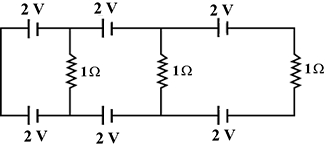
In the below circuit the current in each resistance is