Question
Verify Rolle's theorem of the following function on the indicated interval
$\text{f}(\text{x})=4^{\sin\text{x}}\text{ on }[0,\pi]$

Answer

Here,

$\text{f}(\text{x})=4^{\sin\text{x}}\text{ on }[0,\pi]$

We know that exponential and $\sin\text{x}$ both are continuous and differentiable, so f(x) is continuous is $[0,\pi]$ and differentiable is $(0,\pi).$

Now,

$\text{f}(0)=4^{\sin0}=4^0=1$

$\text{f}(\pi)=4^{\sin\pi}=4^0=1$

$\Rightarrow\text{f}(0)=\text{f}(\pi)$

So, Rolle's theorem is applicable, there must exist a point $\text{c}\in(0,\pi)$ such that f'(c) = 0.

Now,

$\text{f}(\text{x})=4^{\sin\text{x}}$

$\text{f}'(\text{x})=4^{\sin\text{x}}\log4\times\cos\text{x}$

Now,

$\text{f}'(\text{c})=0$

$4^{\sin\text{c}}\times\cos\times\text{c}\log4=0$

$\Rightarrow\cos\text{c}=0$

$\Rightarrow\text{c}=\frac{\pi}{2}\in(0,\pi)$

Hence, Rolle's theorem is verified.

Need a full question paper?

Generate a complete, print-ready paper with questions like this in minutes — across 16+ boards, with answer keys.
Start Generating Free

Similar questions

Determine if f defined by:
$\text{f(x)}=\begin{cases}\text{x}^{2} \sin\frac{1}{\text{x}}, \text{if} \ \text{x}\neq0\\0, \ \ \ \ \ \ \ \ \ \ \ \text{if}\ \text{x} = 0\end{cases}$
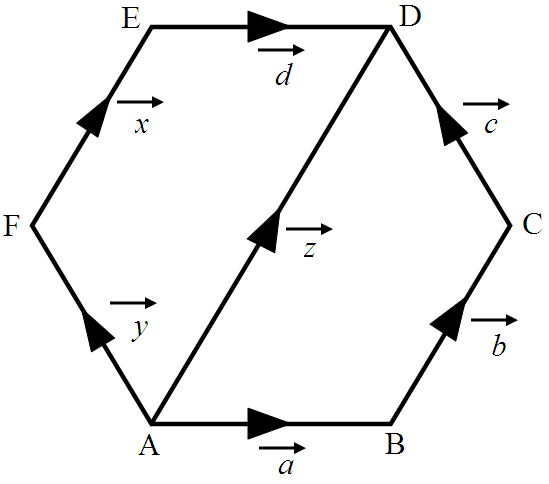
In Figure ABCD is a regular hexagon, which vectors are:
  1. Collinear.
  2. Equal.
  3. Co-initial.
  4. Collinear but not equal.

Differentiate the following functions with respect to x:
$\frac{\sqrt{\text{x}^2+1}+\sqrt{\text{x}^2-1}}{\sqrt{\text{x}^2+1}-\sqrt{\text{x}^2-1}}$
Find the points of discontinuity, if any of the following function:
$\text{f(x)}=\begin{cases}\frac{\sin3\text{x}}{\text{x}},&\text{if }\text{ x}\neq0\\4,&\text{if }\text{ x}=0\end{cases}$
Show that the lines $\frac{5-\text{x}}{-4}=\frac{\text{y}-7}{4}=\frac{\text{z}+3}{-5}$ and $\frac{\text{x}-8}{7}=\frac{2\text{y}-8}{2}=\frac{\text{z}-5}{3}$ are coplanar.
A publisher sells a hard cover edition of a text book for Rs. 72.00 and paperback edition of the same ext for Rs. 40.00. Costs to the publisher are Rs. 56.00 and Rs. 28.00 per book respectively in addition to weekly costs of Rs. 9600.00. Both types require 5 minutes of printing time, although hardcover requires 10 minutes binding time and the paperback requires only 2 minutes. Both the printing and binding operations have 4,800 minutes available each week. How many of each type of book should be produced in order to maximize profit?
A bag A contains 2 white and 3 red balls and a bag B contains 4 white and 5 red balls. One ball is drawn at random from one of the bags and is found to be red. Find the probability that it was drawn from bag B.
Using Lagrange's mean value theorem, prove that
$(\text{b}-\text{a})\sec^2\text{a}<\tan\text{b}-\tan\text{a}<(\text{b}-\text{a})\sec^2\text{b}$
where $0<\text{a}<\text{b}<\frac{\pi}{2}.$
Solve the following differential equation:
$\text{dx + xdy}=\text{e}^{-\text{y}}\sec^2\text{y dy}$
A merchant plans to sell two types of personal computers a desktop model and a portable model that will cost Rs. 25,000 and Rs. 40,000 respectively. He estimates that the total monthly demand of computers will not exceed 250 units. Determine the number of units of each type of computers which the merchant should stock to get maximum profit if he does not want to invest more than Rs. 70 lakhs and his profit on the desktop model is Rs. 4500 and on the portable model is Rs. 5000. Make an LPP and solve it graphically.