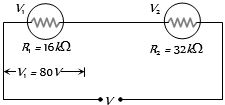
Voltmeters $V_1$ and $V_2$ are connected in series across a $D.C.$ line. $V_1$ reads $80\, volts$ and has a per volt resistance of $200 \,\Omega$. $V_2$ has a total resistance of $32 \,kilo-ohms$. The line voltage is .............
Diffcult
Download our app for free and get started
(d) ${R_1} = 80 \times 200 = 16000\,\Omega = 16\,k\Omega $
Current flowing through ${V_1}$$=$ Current flowing through ${V_2}$ $=$ $\frac{{80}}{{16 \times {{10}^3}}} = 5 \times {10^{ - 3}}\,A$.
So, potential differences across ${V_2}$ is
${V_2} = 5 \times {10^{ - 3}} \times 32 \times {10^3} = 160\,{\rm{volt}}$
Hence, line voltage $V = {V_1} + {V_2} = 80 + 160 = 240\,V$.
Current flowing through ${V_1}$$=$ Current flowing through ${V_2}$ $=$ $\frac{{80}}{{16 \times {{10}^3}}} = 5 \times {10^{ - 3}}\,A$.
So, potential differences across ${V_2}$ is
${V_2} = 5 \times {10^{ - 3}} \times 32 \times {10^3} = 160\,{\rm{volt}}$
Hence, line voltage $V = {V_1} + {V_2} = 80 + 160 = 240\,V$.

Download our appand get started for free
Experience the future of education. Simply download our apps or reach out to us for more information. Let's shape the future of learning together!No signup needed.*
Similar Questions
- 1The length of the resistance wire is increased by $10\%$. What is the corresponding change in the resistance of wire ................ $\%$View Solution
- 2An electrical bulb rated $220\,V , 100\,W$, is connected in series with another bulb rated $220\,V$, $60\,W$.If the voltage across combination is $220\,V$, the power consumed by the $100\,W$ bulb will be about $........... W$View Solution
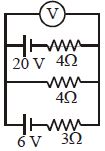
- 3What will be reading of voltmeter ................. $V$View Solution
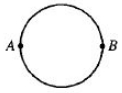
- 4A wire of resistance $12\,ohms$ per meter is bent to form a complete circle of radius $10\, cm.$ The resistance between its two diametrically opposite points, $A$ and $B$ as shown in the figure isView Solution
- 5A $1\,m$ long wire is broken into two unequal parts $X$ and $Y$ The $X$ part of the wire is streched into another wire $W$. Length of $W$ is twice the length of $X$ and the resistance of $W$ is twice that of $Y$. Find the ratio of length of $X$ and $Y$.View Solution
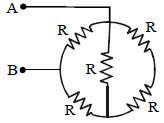
- 6The equivalent resistance between $A$ and $B$ isView Solution
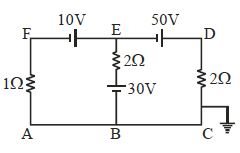
- 7The potential at point $E$ for the given figure is ................ $\mathrm{V}$View Solution
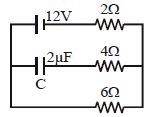
- 8Charge on the capacitor in the given circuit in steady state condition is :- ............... $\mu C$View Solution
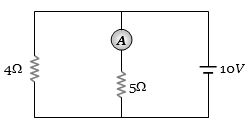
- 9if the internal resistance of the battery is $1\, ohm$, then what is the reading of ammeterView Solution
- 10View SolutionIdentify the set in which all the three materials are good conductors of electricity