MCQ
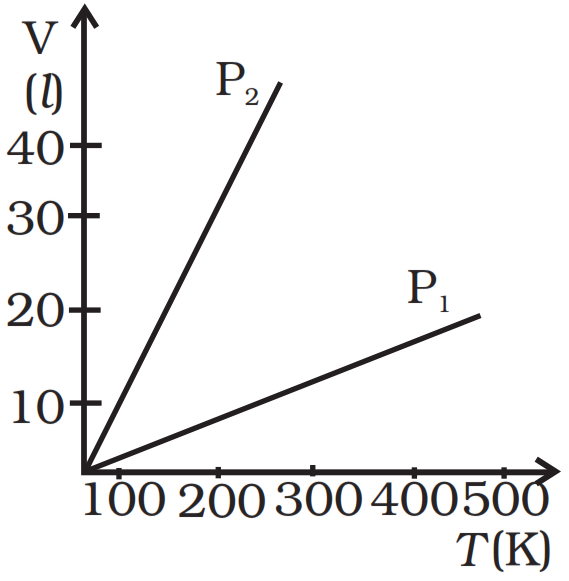
Volume versus temperature graphs for a given mass of an ideal gas are shown in figure. At two different values of constant pressure. What can be inferred about relation between $P_1$ and $P_2$?
  • $P_1 > P_2$
  • B
    $P_{1}=P_2$
  • C
    $P_1< P_2$
  • D
    Data is insufficient.

Answer

Correct option: A.
$P_1 > P_2$
$\text{V}\propto\text{T}$ as $n, R$ and $P$ are constant
$\frac{\text{V}_1}{\text{T}_1} =$ constant or slope of graph is constant
$\text{V}=\frac{\text{nRT}}{\text{P}}$
$\frac{\text{dv}}{\text{dt}}=\frac{\text{nR}}{\text{P}}$
so, $\frac{\text{dV}}{\text{dT}}$ increase when $P$ decreases
$\frac{\text{dV}}{\text{dT}}\alpha\frac{1}{\text{P}}$ as slope of $P_1$ is smaller than $P_2$.
Hence, $P_1 > P_2$ verifies option $(a).$

Need a full question paper?

Generate a complete, print-ready paper with questions like this in minutes — across 16+ boards, with answer keys.

Start Generating Free

Similar questions

A uniform sphere of mass $500\; g$ rolls without slipping on a plane horizontal surface with its centre moving at a speed of $5.00\; \mathrm{cm} / \mathrm{s}$. Its kinetic energy is
When the separation between two charges is increased the electric potential energy of the charges.
A ball of mass $m$ moving with velocity in collides elastically with wall and rebounds. The change in momentum of the ball will be:
Acceleration due to gravity at surface of a planet is equal to that at surface of earth and density is $1.5$ times that of earth. If radius of earth is $R$, radius of planet is .................
Two objects are projected with same velocity ' $u$ ' however at different angles $\alpha$ and $\beta$ with the horizontal. If $\alpha+\beta=90^{\circ}$, the ratio of horizontal range of the first object to the $2^{\text {nd }}$ object will be :
Two simple harmonic motions of angular frequency $100$ and $1000\,\,rad\,s^{-1}$ have the same displacement amplitude. The ratio of their maximum acceleration is
A ball of mass $160\, g$ is thrown up at an angle of $60^{\circ}$ to the horizontal at a speed of $10 \,m / s$. The angular momentum of the ball at the highest point of the trajectory with respect to the point from which the ball is thrown is nearly $\left(g=10\, m / s ^{2}\right)$ (in $kgm ^{2} / s$)
Which of the following statements is/ are true for a simple harmonic oscillator?
$A$ cylinder of radius $R$ made of a material of thermal conductivity ${K_1}$ is surrounded by a cylindrical shell of inner radius $R$ and outer radius $2R$ made of material of thermal conductivity ${K_2}$. The two ends of the combined system are maintained at two different temperatures. There is no loss of heat across the cylindrical surface and the system is in steady state. The effective thermal conductivity of the system is
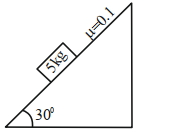
A block of mass $5 \mathrm{~kg}$ is placed on a rough inclined surface as shown in the figure.If $\vec{F}_1$ is the force required to just move the block up the inclined plane and $\vec{F}_2$ is the force required to just prevent the block from sliding down, then the value of $\left|\vec{F}_1\right|-\left|\vec{F}_2\right|$ is : [Use $g=10 \mathrm{~m} / \mathrm{s}^2$ ]