A small sphere of mass $m$ is dropped from a great height. After it has fallen $100\; m$ , it has attained its terminal velocity and continues to fall at that speed. The work done by air friction against the sphere during the first $ 100 \;m $ of fall is
Easy


Download our appand get started for free
Experience the future of education. Simply download our apps or reach out to us for more information. Let's shape the future of learning together!No signup needed.*
Similar Questions
- 1Water is pumped from a depth of $10 $ $m$ and delivered through a pipe of cross section $10^{-2}$ $m^2$. If it is needed to deliver a volume of $10^{-1} $ $m^3$ per second the power required will be ........ $kW$View Solution
- 2A tank $5\, m$ high is half-filled with water and then is filled to the top with oil of density $0.85\, g/cm^3$. The pressure at the bottom of the tank, due to these liquids is ....... $g\, dyne/cm^2$View Solution
- 3View SolutionA small steel ball is dropped into a long cylinder containing glycerine. Which one of the following is the correct representation of the velocity time graph for the transit of the ball?
- 4The pressure acting on a submarine is $3 \times 10^{5}\;Pa$ at a certain depth. If the depth is doubled, the percentage increase in the pressure acting on the submarine would be: (Assume that atmospheric pressure is $1 \times 10^{5} \;Pa$ density of water is $10^{3}\, kg \,m ^{-3}, g =10 \,ms ^{-2}$ )View Solution
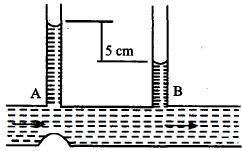
- 5In the diagram shown, the difference in the two tubes of the manometer is $5\, cm$, the cross section of the tube at $A$ and $B$ is $6\, mm^2$ and $10\, mm^2$ respectively. The rate at which water flows through the tube is ........ $ cc/s$ $(g\, = 10\, ms^{-2})$View Solution
- 6A wide vessel with a small hole at the bottom is filled with two liquids. The density and heightof one liquid are $\rho_1$ and $h_1$ and that of the otherare $\rho_2$ and $h_2 \ (\rho_1 >\rho_2)$. The velocity of liquid coming out of the hole is :View Solution
- 7The two thigh bones (femurs), each of cross-sectional area $10\; cm ^{2}$ support the upper part of a human body of mass $40\; kg$. Estimate the average pressure sustained by the femurs.View Solution
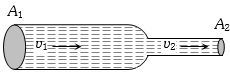
- 8A liquid flows in a tube from left to right as shown in figure. ${A_1}$ and ${A_2}$ are the cross-sections of the portions of the tube as shown. Then the ratio of speeds ${v_1}/{v_2}$ will beView Solution
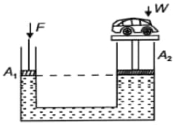
- 9In a hydraulic jack as shown, mass of the car $W=800 \,kg , A_1=10 \,cm ^2, A_2=10 \,m ^2$. The minimum force $F$ required to lift the car is ........... $N$View Solution
- 10A cubical block of steel of each side equal to $l$ is floating on mercury in a vessel. The densities of steel and mercury ar $\rho _s$ and $\rho _m$ . The height of the block above the mercury level is given byView Solution