MCQ
Water drops fall at regular intervals from a tap which is $5\,\,m$ above the ground. The third drop is leaving the tap at the instant the first drop touches the ground. How far above the ground is the second drop at that instant.........$m$
  • A
    $2.50$
  • $3.75$
  • C
    $4$
  • D
    $1.25 $

Answer

Correct option: B.
$3.75$
b
(b) Time taken by first drop to reach the ground $t = \sqrt {\frac{{2h}}{g}} $

$ \Rightarrow \;\;t = \sqrt {\frac{{2 \times 5}}{{10}}} $$ = 1\;\sec $

As the water drops fall at regular intervals from a tap therefore time difference between any two drops $ = \frac{1}{2}\;\sec $

In this given time, distance of second drop from the tap

$ = \frac{1}{2}g{\left( {\frac{1}{2}} \right)^2} = \frac{5}{4} = 1.25\,m$

Its distance from the ground $ = 5 - 1.25 = 3.75\;m$

Need a full question paper?

Generate a complete, print-ready paper with questions like this in minutes — across 16+ boards, with answer keys.

Start Generating Free

Similar questions

The energy of a given sample of an ideal gas depends only on its:
  1. Volume.
  2. Pressure.
  3. Density.
  4. Temperature.
$1\,eV$ is
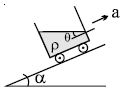
A fluid container is containing a liquid of density $\rho $ is accelerating upward with acceleration a along the inclined place of inclination $\alpha$  as shown. Then the angle of inclination $ \theta $ of free surface is :
Young's modules of material of a wire of length ' $L$ ' and cross-sectional area $A$ is $Y$. If the length of the wire is doubled and cross-sectional area is halved then Young's $modules$ will be :
A wooden cylinder floats vertically in water with half of its length immersed. The density of wood is
The graphs below show angular velocity as a function of time. In which one is the magnitude of the angular acceleration constantly decreasing?
A mass of 5kg is moving along a circular path of radius 1m. If the mass moves with 300 revolutions per minute, its kinetic energy would be:
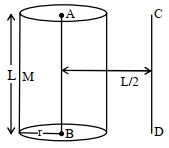
The solid cylinder of length $80\, {cm}$ and mass ${M}$ has a radius of $20\, {cm}$. Calculate the density of the material used if the moment of inertia of the cylinder about an axis $CD$ parallel to ${AB}$ as shown in figure is $2.7\, {kg} {m}^{2}$
In an Isobaric process, the work done by a di$-$atomic gas is $10\, J ,$ the heat given to the gas will be (in $J$)
A particle is made to move from the origin in three spells of equal distances, first along the $x-axis$ , second parallel to $y-axis$ and third parallel to $z-axis$ . One of the forces acting on it is has constant magnitude of $50\  N$ and always acts along the direction of motion. Work done by this force in the three spells of motion are equal and total work done in all the three spells is $300\ J$ . The final coordinates of the particle will be