Water flows into a cylindrical vessel of large cross-sectional area at a rate of $10^{-4}$ $m^3/s$. It flows out from a hole of area $10^{-4}$ $m^2$, which has been punched through the base. How high does the water rise in the vessel?
Diffcult


Download our appand get started for free
Experience the future of education. Simply download our apps or reach out to us for more information. Let's shape the future of learning together!No signup needed.*
Similar Questions
- 1The density of the atmosphere is $1.29\, kg/m^3$, then how high would the atmosphere extend ? $(g = 9.81\, m/sec^2)$ ........ $km$View Solution
- 2View SolutionA boat having some iron pieces is floating in a pond. If iron pieces are thrown in the liquid then level of liquid
- 3Two bodies are in equilibrium when suspended in water from the arms of a balance. The mass of one body is $36 g $ and its density is $9 g / cm^3$. If the mass of the other is $48 g$, its density in $g / cm^3$ isView Solution
- 4View SolutionSelect the correct statement regarding stream line flow
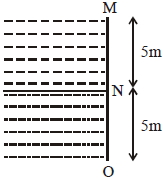
- 5Two liquids of densities $\rho_{1}$ and $\rho_{2}\left(\rho_{2}=2 \rho_{1}\right)$ are filled up behind a square wall of side $10\; \mathrm{m}$ as shown in figure. Each liquid has a height of $5 \;\mathrm{m} .$ The ratio of the forces due to these liquids exerted on upper part $MN$ to that at the lower pait $NO$ is (Assume that the liquids are not mixing)View Solution
- 6Ajet of water having velocity $=$ $10 $ $m/s$ and stream cross-section $=$ $2$ $cm^2$ hits a flat plate perpendicularly, with the water splashing out parallel to plate. The plate experiences a force of ....... $N$View Solution
- 7A block of steel of size $ 5 cm × 5 cm × 5 cm $ is weighed in water. If the relative density of steel is $7,$ its apparent weight isView Solution
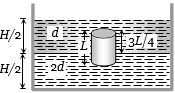
- 8A homogeneous solid cylinder of length $L$$(L < H/2)$. Cross-sectional area $A/5$ is immersed such that it floats with its axis vertical at the liquid-liquid interface with length $L/4$ in the denser liquid as shown in the fig. The lower density liquid is open to atmosphere having pressure ${P_0}$. Then density $D$ of solid is given byView Solution
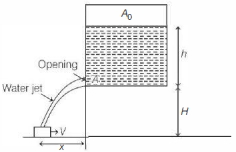
- 9Consider the configuration of a stationary water tank of cross-section area $A_{0}$ and a small bucket as shown in figure below; the speed $v$ is .......... $m/s$ of the bucket, so that the water leaking out of a hole of cross-section area $A$ (as shown) from the water tank does not fall outside the bucket? (Take, $h=5 \,m , H=5 \,m , g=10 \,m / s ^{2}, A=5 \,cm ^{2}$ and $\left.A_{0}=500 \,cm ^{2}\right)$.View Solution
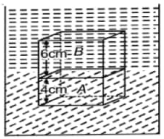
- 10A cube of edge length $10 \,cm$ is just balanced at the interface of two liquids $A$ and $B$ as shown in figure. If $A$ and $B$ has specific gravity $0.6$ and $0.4$ respectively, then mass of cube is ................ $g$View Solution