Question
Water flows through a horizontal pipe of which the cross-section is not constant. The pressure is 1cm of mercury where the velocity is 0.35m/s. Find the pressure at a point where the velocity is 0.65m/s.

Answer

For streamlined flow, the sum of the pressure head, velocity head and gravitational head is a constant, i.e.,$\frac{\text{P}}{\rho\text{g}}+\frac{\text{v}^2}{2\text{g}}+\text{h}=\text{Constant}$
Taking h the same, we have,$\frac{\text{P}_1}{\rho\text{g}}+\frac{\text{v}^2_1}{2\text{g}}=\frac{\text{P}_2}{\rho\text{g}}+\frac{\text{v}^2_2}{2\text{g}}$
$1+\frac{(0.35)^2}{2\text{g}}=\frac{\text{P}_2}{\rho\text{g}}+\frac{(0.65)^2}{2\text{g}}$
$\text{P}_2=\frac{(0.35)^2-(0.65)^2}{2\text{g}}+1$
$=1-\frac{0.3}{2\text{g}}$
$=1-0.015=0.985$
$\therefore$ Pressure = 0.985cm

Need a full question paper?

Generate a complete, print-ready paper with questions like this in minutes — across 16+ boards, with answer keys.
Start Generating Free

Similar questions

The weight of an object is more at the poles than at the equator. Is it benificial to purchase goods at equator and sell them at the pole? Does it matter whether a spring balance is used or an equal-beam balance is used?
A wheel of moment of inertia $0.500kg-m^2$ and radius 20.0cm is rotating about its axis at an angular speed of 20.0rad/s. It picks up a stationary particle of mass 200g at its edge. Find the new angular speed of the wheel.
The average separation between the proton and the electron in a hydrogen atom in ground state is $5.3 \times 10^{-11} m$.
  1. Calculate the Coulomb force between them at this separation.
  2. When the atom goes into its first excited state the average separation between the proton and the electron increases to four times its value in the ground state.What is the Coulomb force in this state?
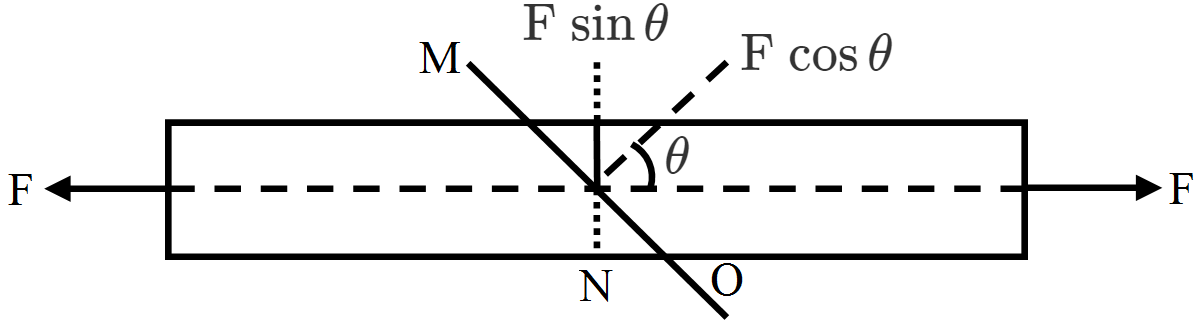
A bar of cross$-$section $A$ is subjected to equal and opposite tensile forces at its ends. Consider a plane section of the bar whose normal makes an angle $q$ with the axis of the bar.
  1. What is the tensile stress on this plane?
  2. What is the shearing stress on this plane?
  3. For what value of $q$ is the tensile stress maximum?
  4. For what value of $q$ is the shearing stress maximum?
Just as precise measurements are necessary in science, it is equally important to be able to make rough estimates of quantities using rudimentary ideas and common observations. Think of ways by which you can estimate the following (where an estimate is difficult to obtain, try to get an upper bound on the quantity): The total mass of rain-bearing clouds over India during the Monsoon.
A $20kg$ box is gently placed on a rough inclined plane of inclination $30°$ with horizontal. The coefficient of sliding friction between the box and the plane is $0.4$. Find the acceleration of the box down the incline.
A particle is released from the top of an incline of height h. Does the kinetic energy of the particle at the bottom of the incline depend on the angle of incline? Do you need any more information to answer this question in Yes or No?
A simple pendulum consists of a 50cm long string connected to a 100g ball. The ball is pulled aside so that the string makes an angle of 37° with the vertical and is then released. Find the tension in the string when the bob is at its lowest position.
A solid sphere rolling on a rough horizontal surface with a linear speed v collides elastically with a fixed, smooth, vertical wall. Find the speed of the sphere after it has started pure rolling in the backward direction.
Two planets have masses in the ratio $1 : 10$ and radii in the ratio $2 : 5$. Compare:
  1. Their densities.
  2. The acceleration due to gravity on their surface.
  3. Escape velocities from their surfaces.
  4. The periods of revolutions of satellites near to their surfaces.