Water is moving with a speed of $5.0\,m/s$ through a pipe of cross sectional area $4.0\,cm^2$ . The water gradually descends $10\,m$ as the pipe increase in area to $8.0\,cm^2$ . If the pressure at the upper level is $1.5 \times 10^5\,Pa$ , the pressure at lower level will be
, Diffcult
Download our app for free and get started
According to equation of continuity
${\mathrm{A}_{1} \mathrm{v}_{1}=\mathrm{A}_{2} \mathrm{v}_{2}}$
or ${\mathrm{v}_{2}=\frac{\mathrm{A}_{1} \mathrm{v}_{1}}{\mathrm{A}_{2}}=\frac{4 \times 10^{-4} \times 5}{8 \times 10^{-4}}=\frac{5}{2} \mathrm{m} / \mathrm{s}}$
According to Bernoulli's theorem
$\mathrm{P}_{1}+\rho \mathrm{gh}_{1}+\frac{1}{2} \rho \mathrm{v}_{1}^{2}=\mathrm{P}_{2}+\rho \mathrm{gh}_{2}+\frac{1}{2} \rho \mathrm{v}_{2}^{2}$
$\mathrm{P}_{2}=\mathrm{P}_{1}+\rho \mathrm{g}\left(\mathrm{h}_{1}-\mathrm{h}_{2}\right)+\frac{1}{2} \rho\left(\mathrm{v}_{1}^{2}-\mathrm{v}_{2}^{2}\right)$
$=1.5 \times 10^{5}+10^{3} \times 10 \times 10+\frac{1}{2} \times 10^{3} \times\left(5^{2}-\left(\frac{5}{2}\right)^{2}\right)$
$=(1.5+1+0.21) \times 10^{5}=2.7 \times 10^{5} \mathrm{Pa}$

Download our appand get started for free
Experience the future of education. Simply download our apps or reach out to us for more information. Let's shape the future of learning together!No signup needed.*
Similar Questions
- 1View SolutionSelect wrong statement about pressure ..........
- 2Consider the wall of a dam to be straight with height $H$ and length $L$. It holds a lake of water of height $h (h < H)$ on one side. Let the density of water be $\rho_{ w }$. Denote the torque about the axis along the bottom length of the wall by $\tau_1$. Denote also a similar torque due to the water up to height $h / 2$ and wall length $L / 2$ by $\tau_2$. Then $\tau_1 / \tau_2$ (ignore atmospheric pressure) isView Solution
- 3A uniform solid cylinder of density $0.8$ $g/cm^3$ floats in equilibrium in a combination of two non-mixing liquid $A$ and $B$ with its axis vertical. The densities of liquid $A$ and $B$ are $0.7$ $g/cm^3$ and $1.2$ $gm/cm^3$. The height of liquid $A$ is $h_A = 1.2$ $cm$ and the length of the part of cylinder immersed in liquid $B$ is $h_B = 0.8$ $cm$. Then the length part of the cylinder in air is ....... $cm$View Solution
- 4A hollow sphere of volume $V$ is floating on water surface with half immersed in it. What should be the minimum volume of water poured inside the sphere so that the sphere now sinks into the waterView Solution
- 5A large drop of oil (density $0.8\,g / cm ^3$ and viscosity $\eta_0$) floats up through a column of another liquid (density $1.2\,g / cm ^3$ and viscosity $\eta_L$ ). Assuming that the two liquids do not mix, the velocity with which the oil drop rises will depend on.View Solution
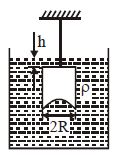
- 6A hemispherical portion of radius $R$ is removed from the bottom of a cylinder of radius $R$. The volume of the remaining cylinder is $V$ and mass $M$. It is suspended by a string in a liquid of density $\rho$, where it stays vertical. The upper surface of cylinder is at a depth $h$ below the liquid surface. The force on the bottom of the cylinder by the liquid isView Solution
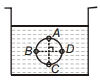
- 7Figure shows a container filled with a liquid of density $\rho$. Four points $A, B, C$ and $D$ lie on the diametrically opposite points of a circle as shown. Points $A$ and $C$ lie on vertical line and points $B$ and $D$ lie on horizontal line. The incorrect statement is $\left(p_A, p_B, p_C, p_D\right.$ are absolute pressure at the respective points)View Solution
- 8View SolutionA man is sitting in a boat which is floating in a pond. If the man drinks same water from the pond, the level of water in pond will
- 9View SolutionIn a turbulent flow, the velocity of the liquid molecules in contact with the walls of the tube is
- 10Water is flowing steadily through a horizontal tube of non uniform cross-section. If the pressure of water is $4$ $\times $ $10^4$ $N/m^2$ at a point where cross-section is $0.02$ $m^2$ and velocity of flow is $2$ $m/s$, what is pressure at a point where cross-section reduces to $0.01$ $m^2$.View Solution