Water $\left(\rho=1000 \,kg / m ^3\right)$ and kerosene $\left(\sigma=800 \,kg / m ^3\right)$ are filled in two identical cylindrical vessels. Both vessels have small holes at their bottom. The speed of the water and kerosene coming out of their holes are $v_1$ and $v_2$ respectively. Select the correct alternative
Easy


Download our appand get started for free
Experience the future of education. Simply download our apps or reach out to us for more information. Let's shape the future of learning together!No signup needed.*
Similar Questions
- 1A spherical solid ball of volume $V$ is made of a material of density $\rho_1$ . It is falling through a liquid of density $\rho_2 (\rho_2 < \rho_1 )$. Assume that the liquid applies a viscous force on the ball that is proportional to the square of its speed $v$, i.e., $F_{viscous}= -kv^2 (k >0 )$,The terminal speed of the ball isView Solution
- 2Two liquids of densities $d_1$ and $d_2$ are flowing in identical capillary tubes uder the same pressure difference. Ift $t_1$ and $t_2$ are time taken for the flow of equal quantities (mass) of liquids, then the ratio of coefficient of viscosity of liquids must beView Solution
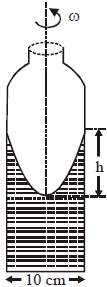
- 3A cylindrical vessel containing a liquid is rotated about its axis so that the liquid rises at its sides as shown in the figure. The radius of vessel is $5\, cm$ and the angular speed of rotation is $\omega\; rad \,s^{-1}$. The difference in the height, $h($ in $cm )$ of liquid at the centre of vessel and at the side will beView Solution
- 4Different physical quantities are given in Column - $\mathrm{I}$ and their dimensional formula are given in Column - $\mathrm{II}$. Match them appropriately.View Solution
Column - $\mathrm{I}$ Column - $\mathrm{II}$ $(a)$ Viscous force $(i)$ $\left[ {{M^1}{L^1}{T^{ - 2}}} \right]$ $(b)$ Coefficient of viscosity $(ii)$ $\left[ {{M^1}{L^{ - 1}}{T^{ - 1}}} \right]$ $(iii)$ $\left[ {{M^1}{L^{ - 1}}{T^{ - 2}}} \right]$ - 5A cylinder of height $ 20\; m$ is completely filled with water. The velocity of efflux of water (in $ m/s$) through a small hole on the side wall of the cylinder near its bottom is ....... $m/s$View Solution
- 6The value of $g $ at a place decreases by $ 2\%.$ The barometric height of mercuryView Solution
- 7A metallic body of material with density of $8000\ kg/m^3$ has a cavity inside. A spring balance shows its mass to be $10.0\ kg$ in air and $7.5\ kg$ when immersed in water. The ratio of the volume of the cavity to the volume of the material of the body must beView Solution
- 8Water enters through end $A$ with speed ${v_1}$ and leaves through end $B$ with speed ${v_2}$ of a cylindrical tube $AB$. The tube is always completely filled with water. In case $I$ tube is horizontal and in case $ II$ it is vertical with end $ A $ upwards and in case $ III $ it is vertical with end $B$ upwards. We have ${v_1} = {v_2}$ forView Solution
- 9An object with uniform density $\rho$ is attached to a spring that is known to stretch linearly with applied force as shown below.When the spring object system is immersed in a liquid of density $\rho_1$ as shown in the above figure, the spring stretches by an amount $x_1\left(\rho > \rho_1\right)$. When the experiment is repeated in a liquid of density $\left(\rho_2 < \rho_1\right)$, the spring stretches by an amount $x_2$. Neglecting any buoyant force on the spring, the density of the object isView Solution
- 10$A U-$ tube having horizontal arm of length $20$ $cm$, has uniform cross-sectional area $=1\ cm^2$. It is filled with water of volume $60$ $cc$. What volume of a liquid of density $4$ $g/cc$ should be poured from one side into the $U -$ tube so that no water is left in the horizontal arm of the tube ........ $cc$ ?View Solution