Two liquids of densities $d_1$ and $d_2$ are flowing in identical capillary tubes uder the same pressure difference. Ift $t_1$ and $t_2$ are time taken for the flow of equal quantities (mass) of liquids, then the ratio of coefficient of viscosity of liquids must be
Medium
Download our app for free and get started
(a)
According to poiseuille's equation, Volume of liquid flowing per second in a capillary tube is given by
$Q =\frac{ V }{ t }=\frac{\pi r ^4 \Delta P }{8 \eta L }$
So mass of liquid flowing in a capillary tube is given by
$Q _{ m }=\frac{ m }{ t }=\frac{\pi r ^4 \Delta P }{8 \eta L } d$
$\Rightarrow \frac{ m _1}{ t _1}=\frac{\pi r ^4 \Delta P }{8 \eta_1 L } d _1 \ldots(I)$
$\Rightarrow \frac{ m _2}{ t _2}=\frac{\pi r ^4 \Delta P }{8 \eta_2 L } d _2 \ldots(II)$
Dividing $(I)$ by $(II)$, we have
$\frac{ t _2}{ t _1}=\frac{ d _1}{ d _2} \times \frac{\eta_2}{\eta_1}$
$\Rightarrow \frac{\eta_1}{\eta_2}=\frac{ d _1 t _1}{ d _2 t _2}$

Download our appand get started for free
Experience the future of education. Simply download our apps or reach out to us for more information. Let's shape the future of learning together!No signup needed.*
Similar Questions
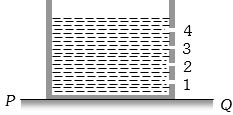
- 1A cylindrical vessel of $90 cm$ height is kept filled upto the brim. It has four holes $ 1, 2, 3, 4$ which are respectively at heights of $20 cm, 30 cm, 45 cm $ and $50 cm$ from the horizontal floor $PQ.$ The water falling at the maximum horizontal distance from the vessel comes fromView Solution
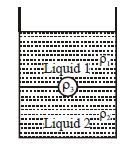
- 2Diagram shows a jar filled with two non mixing liquids $1$ and $2$ having densities ${\rho _1}$ and ${\rho _2}$ respectively. A solid ball, made of a material of density ${\rho _3}$ , is dropped in the jar. It comes to equilibrium in the position shown in the figure. Which of the following is true for ${\rho _1}$ , ${\rho _2}$ and ${\rho _3}$ ?View Solution
- 3A Spherical ball of radius $1 mm$ and density $10.5 g / cc$ is dropped in glycerine of coefficient of viscosity $9.8$ poise and density $1.5 g / cc$. Viscous force on the ball when it attains constant velocity is $3696 \times 10^{-x} N$. The value of $x$ is $\text { (Given, } g =9.8 m / s ^2 \text { and } \pi=\frac{22}{7} \text { ) }$View Solution
- 4$A U-$ tube having horizontal arm of length $20$ $cm$, has uniform cross-sectional area $=1\ cm^2$. It is filled with water of volume $60$ $cc$. What volume of a liquid of density $4$ $g/cc$ should be poured from one side into the $U -$ tube so that no water is left in the horizontal arm of the tube ........ $cc$ ?View Solution
- 5A submarine experiences a pressure of $5.05\times 10^6\,Pa$ at a depth of $d_1$ in a sea. When it goes further to a depth of $d_2,$ it experiences a pressure of $8.08\times 10^6\,Pa.$ Then $d_2 -d_1$ is approximately ........ $m$ (density of water $= 10^3\,kg/m^3$ and acceleration due to gravity $= 10\,ms^{-2}$ )View Solution
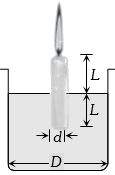
- 6A candle of diameter $ d$ is floating on a liquid in a cylindrical container of diameter $D $ $(D>>d)$ as shown in figure. If it is burning at the rate of $2$ cm/hour then the top of the candle willView Solution
- 7Three liquids of equal masses are taken in three identical cubical vessels $A, B$ and $C .$ Their densities are $\rho_{A}, \rho_{B}$ and $\rho_{C} \cdot$ The force exerted by the liquid on the base of the cubical vessel isView Solution
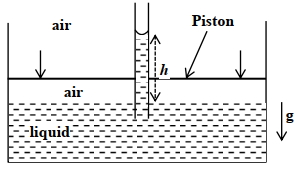
- 8An incompressible liquid is kept in a container having a weightless piston with a hole. A capillary tube of inner radius $0.1 \mathrm{~mm}$ is dipped vertically into the liquid through the airtight piston hole, as shown in the figure. The air in the container is isothermally compressed from its original volume $V_0$ to $\frac{100}{101} V_0$ with the movable piston. Considering air as an ideal gas, the height $(h)$ of the liquid column in the capillary above the liquid level in $\mathrm{cm}$ is. . . . . . .View Solution
[Given: Surface tension of the liquid is $0.075 \mathrm{Nm}^{-1}$, atmospheric pressure is $10^5 \mathrm{~N} \mathrm{~m}^{-2}$, acceleration due to gravity $(g)$ is $10 \mathrm{~m} \mathrm{~s}^{-2}$, density of the liquid is $10^3 \mathrm{~kg} \mathrm{~m}^{-3}$ and contact angle of capillary surface with the liquid is zero]
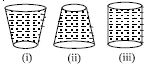
- 9View SolutionThe three water filled tanks shown have the same volume and height. If small identical holes are punched near this bottom, which one will be the first to get empty.
- 10A large tank is filled with water (density $=$ $10^3 $ $kg/m^3$).A small hole is made at a depth $10$ $m$ below water surface. The range of water issuing out of the hole is Ron ground. What extra pressure must be applied on the water surface so that the range becomes $2R $ (take $1$ $atm$ $=$ $10^5$ $Pa$ and $g$ $=$ $10$ $m/s^2):$ ...... $atm$View Solution