MCQ
Wavefront of a wave has direction with wave motion
  • A
    Parallel
  • Perpendicular
  • C
    Opposite
  • D
    At an angle of $\theta$

Answer

Correct option: B.
Perpendicular
b
(b)Direction of wave is perpendicular to the wavefront.

Need a full question paper?

Generate a complete, print-ready paper with questions like this in minutes — across 16+ boards, with answer keys.

Start Generating Free

Similar questions

A man standing in a swimming pool looks at a stone lying at the bottom. The depth of the swimming pool is h. At what distance from the surface of water is the image of the stone formed (Line of vision is normal; Refractive index of water is n)
The electric intensity due to a dipole of length $10\, cm$ and having a charge of $500\,\mu C$, at a point on the axis at a distance $20\, cm$ from one of the charges in air, is
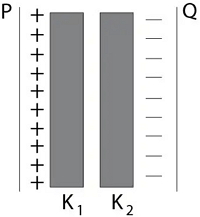
Two thin dielectric slabs of dielectric constants $K_1$ and $K_2$ $(K_1 < K_2)$ are inserted between plates of a parallel plate capacitor, as shown in the figure. The variation of electric field $E$ between the plates with distance $d$ as measured from plate $P$ is correctly shown by
Relation between current (i) and drift velocity $\left(v_d\right)$ is :
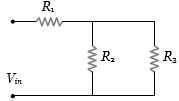
For ensuring dissipation of same energy in all three resistors $({R_1},\,{R_2},\,{R_3})$ connected as shown in figure, their values must be related as 
The phenomenon of change in the $.........$ of light when it passes from one transparent medium to another is refraction.
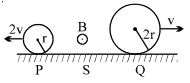
Two conducting rings $P$ and $Q$ of radii $r$ and $2r$ rotate uniformly in opposite directions with centre of mass velocities $2v$ and $v$ respectively on a conducting surface $S$. There is a uniform magnetic field of magnitude $B$ perpendicular to the plane of the rings. The potential difference between the highest points of the two rings is
An electron revolves around the nucleus of hydrogen atom in a circle of radius $5 \times 10^{-11} m$. The intensity of electric field at a point in the orbit of the electron is:
Choose the correct option:
An electron moves in a circular orbit with a uniform speed $v$. It produces a magnetic field $B$ at the centre of the circle. The radius of the circle is proportional to