Question
We have valence electrons and conduction electrons in a semiconductor. Do we also have 'valence holes' and 'conduction holes'?

Answer

Holes do not exist in reality. They exist only virtually. When an electron jumps from the valence band to the conduction band, a vacancy is created at the place from where the electron had jumped. This vacancy is called a hole. So, a valence or conduction hole is a virtual concept only.

Need a full question paper?

Generate a complete, print-ready paper with questions like this in minutes — across 16+ boards, with answer keys.
Start Generating Free

Similar questions

Can we find the mass of a photon by the definition p = mv?
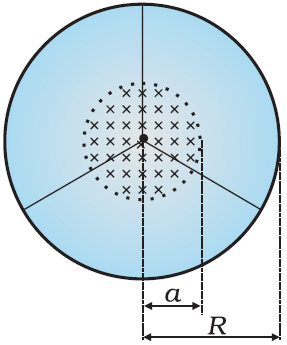
A line charge $\lambda$ per unit length is lodged uniformly onto the rim of a wheel of mass $M$ and radius $R.$ The wheel has light non-conducting spokes and is free to rotate without friction about its axis $($Fig.$). A$ uniform magnetic field extends over a circular region within the rim. It is given by,
$B = – B_0k (r \leq a; a < R)$
$= 0 ($otherwise$)$
What is the angular velocity of the wheel after the field is suddenly switched off?
Suppose the resistance of the coil in the preivous problem is $25\Omega.$ Assume that the coil moves with uniform velocity during its removal and restoration. Find the thermal energy developed in the coil during:
  1. Its removal.
  2. Its restoration.
  3. Its motion.
Explain frequency and wavelength of electromagnetic spectrum.
State briefly the underlying principle of a transistor oscillator. Draw a circuit diagram showing how the feedback is accomplished by inductive coupling. Explain the oscillator action.
A cyclotron’s oscillator frequency is 10 MHz. What should be the operating magnetic field for accelerating protons? If the radius of its ‘dees’ is 60 cm, calculate the kinetic energy (in MeV) of the proton beam produced by the accelerator.
What is the advantage of using thick metallic strips to join wires in a potentiometer?
A particle starts from the origin, goes along the X-axis to the point (20m, 0) and then returns along the same line to the point (-20m, 0). Find the distance and displacement of the particle during the trip.
Three point charges $+Q, -2Q$ and $-3Q$ are placed at the vertices of an equilateral triangle $\text{ABC}$ of side l.
If these charges are displaced to the mid points $A_1, B_1$ and $C_1$ respectively, calculate the amount of work done in shifting the charges to the new locations.
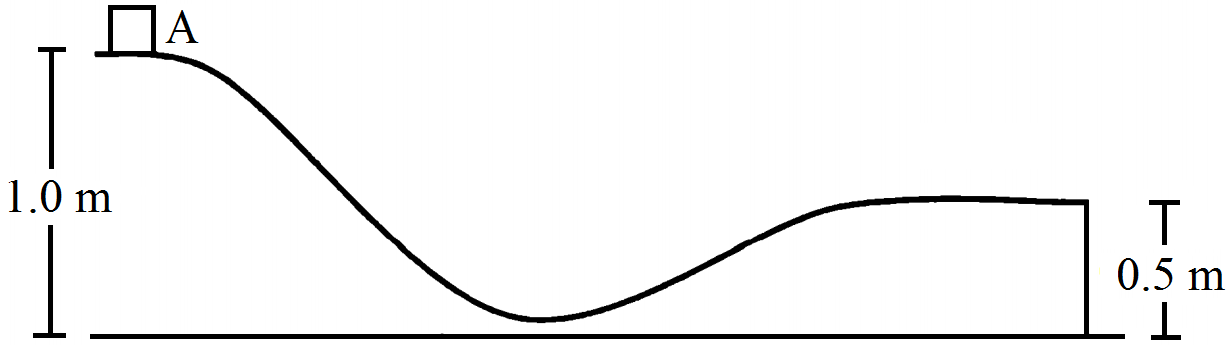
Figure shows a particle sliding on a frictionless track which terminates in a straight horizontal section. If the particle starts slipping from the point A, how far away from the track will the particle hit the ground?