MCQ
Weights of $1\,g,2\,g.....,100\,g$ are suspended from the $1 \,cm, 2 \,cm, ...... 100\, cm, \,marks$ respectively of a light metre scale. Where should it be supported for the system to be in equilibrium ...... $cm$ mark.
  • A
    $55$
  • B
    $60$
  • $66$
  • D
    $72$

Answer

Correct option: C.
$66$
c
$\cdot$ Weights are $1 \mathrm{g}, 2 \mathrm{g}, 3 \mathrm{g}, \ldots \ldots .100 \mathrm{g}$

$\cdot$ Weights are suspended at a distance $=1 \mathrm{cm}, 2 \mathrm{cm}, 3 \mathrm{cm}, \ldots \ldots .100 \mathrm{cm}$

respectively to the masses.

For the system to be in equilibrium the point must lie in the center of mass.

So center of mass of the system can be calculated as

$\mathrm{COM}=\frac {\left(1^{2}+2^{2}+3^{2} \ldots 100^{2}\right)} {(1+2+3 \ldots+100)}$

$COM = \left[ {\frac{{\frac{{\left( {100} \right)\left( {101} \right)\left( {201} \right)}}{6}}}{{\frac{{\left( {100} \right)\left( {101} \right)}}{2}}}} \right]$

$\mathrm{COM}=\frac {201}{3}=67 \mathrm{cm}$

Hence at $67 \mathrm{cm}$ from the origin or $66 \mathrm{cm}$ from the first particle, at that point system will be supported to get equilibrium.

Need a full question paper?

Generate a complete, print-ready paper with questions like this in minutes — across 16+ boards, with answer keys.

Start Generating Free

Similar questions

A body rotates about a fixed axis with an angular acceleration of $3 \,rad / s ^2$. The angle rotated by it during the time when its angular velocity increases from $10 \,rad / s$ to $20 \,rad / s$ (in radian) is ..........
A block of mass $m$ is kept in an elevation which starts moving downward with an acceleration $a$ as shown in figure. The block is observed by two observers $A$ and $B$ for a time interval $t_0$. The observer $B$ finds that the work done by gravity on the block is
Water is flowing in a horizontal pipe of unequal cross-section. At the narrow place in the pipe there will be:
The equation of a stationary wave along a stretched string is given by $y = 5\,sin\, \frac{2\pi }{3}x\, cos\, 40\pi t$ where $x$ and $y$ are in $cm$ and $t$ is in $s$. The separation between two adjacent nodes is ..... $cm$
A particle of mass $ 0.3 \,kg$ is subjected to a force $F = - kx$ with $k = 15\,N/m.$ What will be its initial acceleration if it is released from a point $20 \,cm$ away from the origin .......... $m/s^2$
A boat crosses a river with a velocity of $8\, km/h$. If the resulting velocity of boat is $10 \,km/h $ then the velocity of river water is...........$km/h$
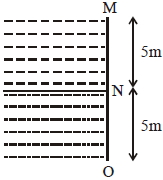
Two liquids of densities $\rho_{1}$ and $\rho_{2}\left(\rho_{2}=2 \rho_{1}\right)$ are filled up behind a square wall of side $10\; \mathrm{m}$ as shown in figure. Each liquid has a height of $5 \;\mathrm{m} .$ The ratio of the forces due to these liquids exerted on upper part $MN$ to that at the lower pait $NO$ is (Assume that the liquids are not mixing)
There is a hole in the bottom of tank having water. If total pressure at bottom is $ 3 atm$  ($1 atm = 10^5N/m^2$) then the velocity of water flowing from hole is
Thickness of a pencil measured by using a screw gauge (least count $0.001 \,cm$ ) comes out to be $0.802 \,cm$. The percentage error in the measurement is ........... $\%$
If the initial velocity of a projectile be doubled, keeping the angle of projection same, the maximum height reached by it will