Sources of Corporate Finance — Secretarial Practice STD 12 Commerce / Arts — Question
Maharashtra BoardEnglish MediumSTD 12 Commerce / ArtsSecretarial PracticeSources of Corporate Finance8 Marks
Question
What are a share and state its features?
✓
Answer
The term share is defined by section 2(84) of the Companies Act 2013 ‘Share means a share in the share capital of a company and includes stock.’ The capital of a company is divided into a large number of shares.
It facilitates the public to subscribe to the company’s capital in smaller amounts.
The share is thus, an indivisible unit of share capital.
It is a unit by which the share capital is divided.
The total capital is divided into small parts and each such part is called a share.
The value of each part/unit is known as face value.
A person can purchase any number of shares as and when he or she desires.
A person who purchases shares of the company is known as a shareholder of the company.
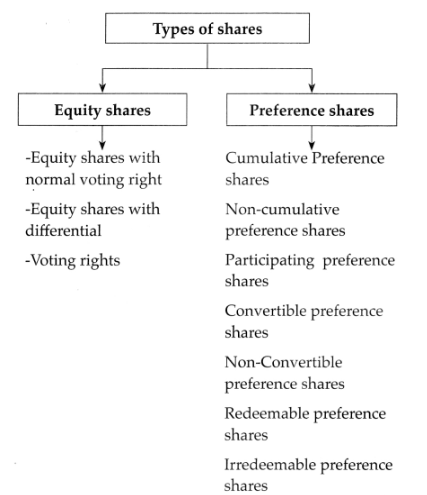
Generally, companies issue equity shares and preference shares in the market.
Features of shares: (i) Meaning:
Share is the smallest unit in the total share capital of a company.
The total share capital of a company is divided into small parts and each part is called a share.
(ii) Ownership:
A share shows the ownership of the shareholder.
The owner of the share is called a shareholder.
(iii) Distinctive number:
Unless dematerialized, each share has a distinct number, which is noted in the share certificate.
A share has a distinct number for identification.
(iv) Evidence of title:
The company issues a share certificate under its common seal.
It is a document of title of ownership of the share.
A share is not a visible thing.
It is shown by share certificate or in the form of ‘Demat share’
(v) Value of a share:
Each share has a value expressed in terms of money.
Face value: This value is written on the share certificate and mentioned in the Memorandum of Association.
Issue Value: It is the price at which a company sells its shares. At par – equal to face value; At premium – more than the face value; At discount – Less than the face value.
(vi) Rights:
A share confers/gives certain rights to the shareholders.
Rights such as the right to receive dividends, right to inspect statutory books, right to attend shareholders’ meetings, right to vote in meetings, etc. (group rights), and right to receive notice, circulars, dividends, bonus shares, rights issue, etc. (individual rights).
(vii) Income:
A shareholder is entitled to get a share in the net profit of the company.
It is called a dividend.
(viii) Transferability:
The shares of the public Ltd. company are freely transferable as per the rules laid down in the Articles of Association.
Shares of a private company cannot be transferred.
(ix) Property of shareholder:
A share is a movable property of a member.
It can be transferred (gifted, sold) or transmitted (passed on to the legal heir after/due to death, insolvency or insanity of a member).
(x) Kinds of shares:
A company issues two types of shares depending upon the right to control, income and risk.
Equity shares – which do not carry preferential right to receive dividend or repayment of capital when the company winds up its activities.
Preference shares – which carry preferential rights as regards dividend and repayment of capital in the event of winding up of the company.
Need a full question paper?
Generate a complete, print-ready paper with questions like this in minutes — across 16+ boards, with answer keys.