Question
What are abiotic factors? Write examples.

Answer

All inanimate and non-living things are together termed as abiotic factors.
Abiotic factors are divided further into physical and chemical factors.
(a) Physical components: Sunlight, Temperature, Heat, pressure, humidity.
(b) Chemical components: Air, water, soil, minerals, gases, chemical compounds.

Need a full question paper?

Generate a complete, print-ready paper with questions like this in minutes — across 16+ boards, with answer keys.
Start Generating Free

Similar questions

In a Std. X class, out of 40 students, 10 students use spectacles, 2 students have ( positive power and 8 students have negative power of lenses in their spectacles.
Answer the following questions:
(1) What does the negative power indicate?
(2) What does the positive power indicate?
(3) Generally which type of spectacles do most of the students use?
(4) What defect of eyesight do most of the students suffer from?
(5) Give two possible reasons for the above defect.

Image

A rainbow is the combined effect (an exhibition) of the refraction, dispersion, and total internal reflection of light (taken together). (Practice Activity Sheet – 1)
(OR)
With a neat labelled diagram, explain how the formation of rainbow occurs.
Read the passage and answer the questions based on it.
If heat is exchanged between a hot and cold object, the temperature of the cold object goes on increasing due to gain of energy and the temperature of the hot object goes on decreasing due to loss of energy. The change in temperature continues till the temperatures of both objects attain the same value. In this process, the cold object gains heat energy and the hot object loses heat energy. If the system of both the objects is isolated from the environment by keeping it inside a heat-resistant box then no energy can flow from inside the box or come into the box. In this situation, we get the following principle.
Heat energy lost by the hot object = Heat energy gained by the cold object. This is called the ‘Principle of heat exchange’.
  1. Where does heat transfer take place?
  2. In such a situation which principle of heat do you perceive?
  3. How can this principle be explained in short?
  4. Which property of the substance is measured using this principle?
From incident white light how will you obtain white emergent light by making use of two prisms?
Explain the following terms with example: Structural isomerism.
Draw a labelled diagram of the human digestive system. With the help of this diagram, describe the process of digestion of food in man (humans).
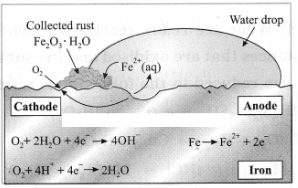
Anodes need to be replaced from time to time during the electrolysis of alumina.
Explain how harmful chemicals enter our bodies.
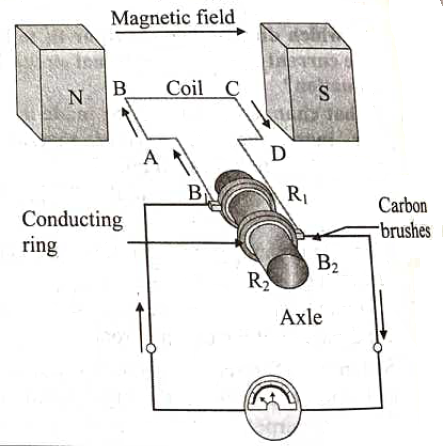
Observe the following diagram and answer the questions given below:

Image
i. Identify the above diagram.
ii. Write the principle on which the above appliance works.
iii. write the working of the above appliance.
iv. Write the use of the above appliance.