Question
What are bacterial phages? Describe their structure in detail.

Answer

Viruses which infect and destroy bacteria are called bacteriophages. The word phage is derived from the Greek word ‘phagos’ which means to feeding others. These were discovered separately by Dwart and D'Harrell. Like bacteria, bacteriophages are found in almost every type of habitat and natural conditions. From the point of view of morphology, there are huge difference between them.
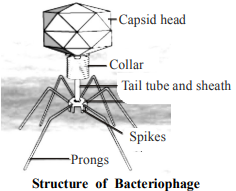
Structure of a Bacteriophage : The structure of a typical bacteriophage is similar to that of a tadpole, which is differentiated into a clear head and tail. Most bacteriophages $\left( T _2, T_6\right)$ is head prismatic while its tail is long and cylindrical, the tail remain attached to the prismatic head. With its help they attach to the bacterial cell.
Its length is approximately is equal to the length of the head. The prismatic head is made of protein molecule and its central core contains a large molecule of long DNA. There is a collar between the head and tail. At the proximal end of the tail there is a hexagonal plate attached to the collar, which is called the base plate. Six tail fibers are attached to the lower surface of the base plate with the help of which the phage remains stuck to the surface of the bacteria and the enzymes secreted by them hefp in fusion (lysis) with the bacterial wall.
Image

Need a full question paper?

Generate a complete, print-ready paper with questions like this in minutes — across 16+ boards, with answer keys.

Start Generating Free

Similar questions

With the help of suitable diagram describe the logistic population growth curve.
The population explosion in India has led to food crisis in recent times. It is felt that we need another green revolution.
  1. What in your opinion, are the major limitations of the first Green Revolution of 1960s?
  2. Name the crop varieties introduced into India after this.
  3. How will you explain the harmful aspects of using chemicals as fertilisers and pesticides.
  4. What values do you promote by this?
A youth in his twenties met with an accident and succumbed to the injuries. His parents agreed to donate his organs. So, their:
  1. List any two essential clinical steps to be undertaken before any organ transplant.
  2. Why is the transplant rejected sometimes?
  3. What views would you share with your health club members to promote organ donation?
  1. How is amensalism different from parasitism and competition? Give an example for each.
  2. Define predation.
What are three options to increase food production? Discuss each giving the salient features, merits and demerits.
In one family, the four children each have a different blood group. Their mother has blood group A and their father has blood group B. Work out a cross to explain how it is possible.
Describe the disease 'AIDS' under the following headings :
(i) Name of the pathogen
(ii) Name of the test to confirm the disease
(iii) Four main symptoms of the disease
(iv) Four measures of prevention
(v) Picture of viral replication.
Rose plants produce large, attractive bisexual flowers but they seldom produce fruits. On the other hand a tomato plant produces plenty of fruits though they have small flowers. Analyse the reasons for failure of fruit formation in rose.
Both these plants - rose and tomato - both selected by human beings for different characteristics, the rose for its flower and tomato for its fruit. Roses, being vegetatively propagated do not need to produce seeds.
  1. Explain taking one example of vertebrates anatomy that evolution of life has occurred on earth.
  2. 'Nature selects for fittest.' Explain with suitable examples.
Draw a neat diagram of the female reproductive system and label the parts associated with the following.
  1. Production of gamete.
  2. Site of fertilisation.
  3. Site of implantation.
  4. Birth canal.