Question
What are co-initial and collinear vectors?

Answer

Two vectors having the same initial point are called co-initial vectors. Two vectors which either act along the same line or along parallel lines are called collinear vectors.

Need a full question paper?

Generate a complete, print-ready paper with questions like this in minutes — across 16+ boards, with answer keys.

Start Generating Free

Similar questions

The speed of wave is 360 m/sec. And the frequency is 500 Hz. and the phase difference between adjacent particle is $60^{\circ} $. What will be the path difference between them?
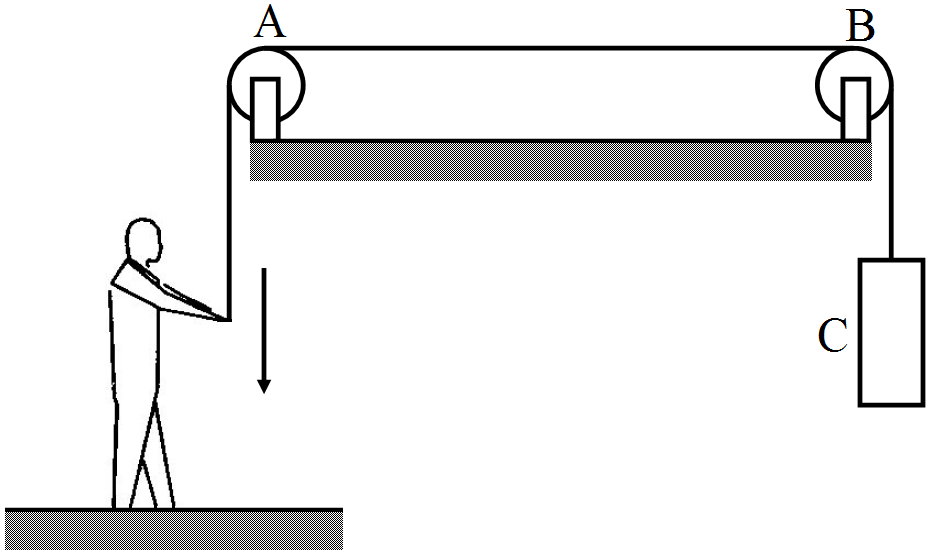
List all the forces acting on:
  1. The pulley $A.$
  2. The boy and.
  3. The block $C$ in figure.
An astronaut inside a small space ship orbiting around the earth cannot detect gravity. If the space station orbiting around the earth has a large size, can he hope to detect gravity?
In a horizontal pipe line of uniform area of cross section, the pressure falls by $8N-m^2$ between two points separated by a distance of $1km$. What is the change in kinetic energy per kg of the oil flowing at these points? Density of oil is $806kg-m^{-3}$.
What is the acceleration due to gravity at the bottom of a sea 30km deep taking radius of the earth as 6.3 × 10km?
Why can't we use a pendulum to work as a clock in a satellite?
When a weight 'W' is hung from one end of the wire, other end being fixed, the elongation produced on it be 'l’. If this wire goes over a pulley and two weights 'W' each are hung at the two ends, what will be the total elongation in the wire?
A particle executes simple harmonic motion. If you are told that its velocity at this instant is zero, can you say what is its displacement? If you are told that its velocity at this instant is maximum, can you say what is its displacement?
If a constant potential difference is applied across a bulb, the current slightly decreases as time passes and then becomes constant. Explain.
In Exercise, let us take the position of mass when the spring is unstreched as x = 0, and the direction from left to right as the positive direction of x-axis. Give x as a function of time t for the oscillating mass if at the moment we start the stopwatch (t = 0), the mass is:
At the mean position.
In what way do these functions for SHM differ from each other, in frequency, in amplitude or the initial phase?